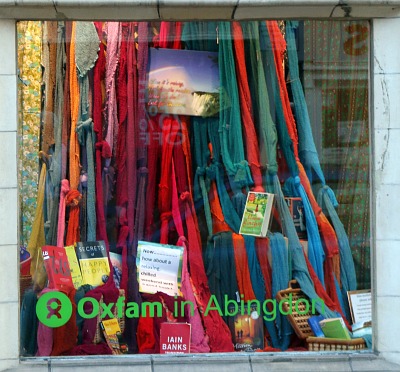
My heart leaps up when I behold a rainbow in the Oxfam Shop Window

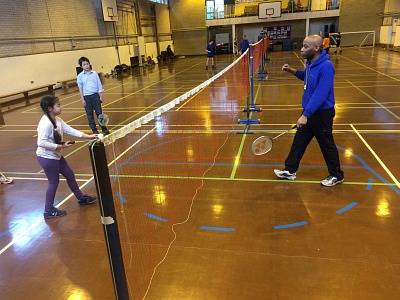
Smash Badminton Club
The Oxfam Shop in Abingdon has a rainbow window made of mostly scarves and a few books.

My heart leaps up when I behold
A rainbow in the sky:
So was it when my life began;
So is it now I am a man;
So be it when I shall grow old,
Or let me die!
The Child is father of the Man;
And I could wish my days to be
Bound each to each by natural piety.

Poem by William Wordsworth

Smash! Badminton Club

During the recent Club and Societies Day report I missed the Smash Badminton Club, so here thanks to Chris are a few details.
Smash Badminton Club
Established over 20 years ago, the Smash! badminton club is run by volunteers and provides a structured environment for young people 7 -18 of all abilities to play and develop their badminton skills. They play on Saturday mornings at the Sports Hall of St Helen and St Katherine School from September to April. Currently it is the close season, but their website www.smashbc.org.uk has contact details for anybody wanting to get in touch. Then put it in the diary for after the summer holidays.

The World Comes to St Ethelwold’s House

St Ethelwold's House
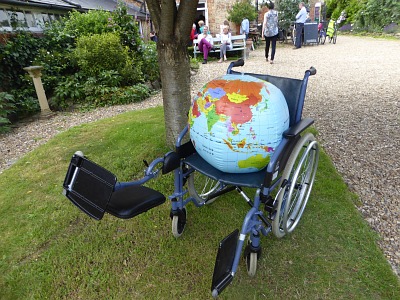
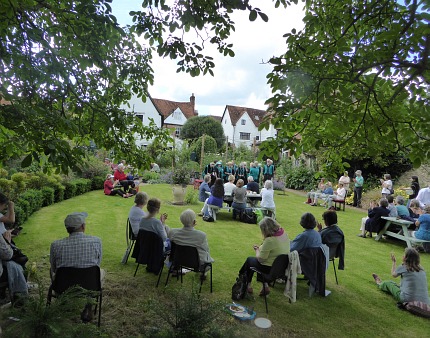
The world arrived in a wheelchair having had a difficult week, but this event at St Ethelwold’s called ‘A Celebration of Summer’ tried to put that right.
St Ethelwold's House
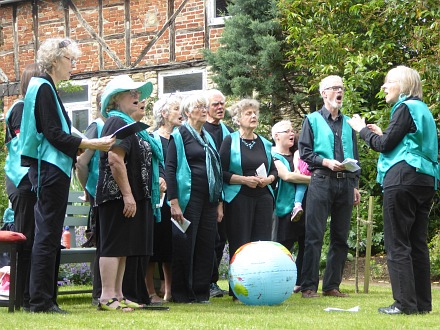
There were songs of Peace and Social Justice by the Seagreen Singers
St Ethelwold's House
and circle dancing as people sat out on the lawn at St Ethelwold’s House enjoying the music, the tea and cakes.

This was followed by a time in the Sanctuary listening to the words of some of the great teachers of this world. By the end of the afternoon we hope the world is feeling more resilient and able to cope with whatever next week brings.

Bionic Hearing

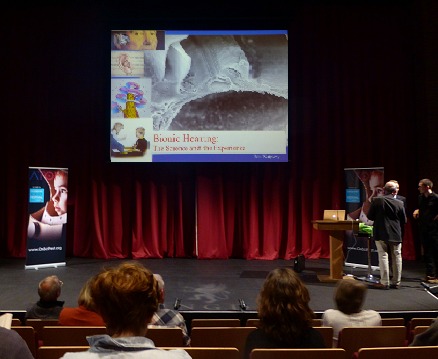
As part of the Oxford Science Festival there have been a series of talks at the Amey Theatre at Abingdon School over the last few days.
Bionic Hearing
On Saturday evening we went to hear Professeur Ian Shipsey talk on ‘Bionic Hearing:The Science and the Experience’.

The most common cause of deafness is damage to the sensitive hairs of the inner ear (cochlea). For most people with hearing loss a hearing aid is the best and cheapest remedy and works by amplifying sound. For people with severe hearing loss, the cochlear implant or “bionic ear” developed in the late 1990s is the best approach. Over 200,000 people worldwide have regained their hearing using this device. An external microphone and digital sound processor transmit sound to an internal receiver that sends signals to 10 electrodes implanted into different points on the cochlear from high to low tones.

As one of the beneficiaries Professeur Ian Shipsey spoke movingly about regaining his hearing in 2002, after 12 years of deafness, and hearing his child’s voice for the first time. Professeur Shipsey is a Professeur of Physics but he hopes by doing these lectures on Cochlear Implants to reach others who can benefit from the procedure.

It was fascinating to hear sentences spoken, and music played, as he hears them with his implant.