Abingdon Flower Club displays last weekend


Last weekend in Abingdon was a mix of old and new, of history and creativity. Among the creativity were flower displays.

Abingdon Flower Club had floral displays across some of Abingdon’s open venues. Their arrangements could be seen in the Roysse Room at the Guildhall, under the County Hall, in Unit 25 on Bury Street among others.

On the Market Place, members invited passers-by to make hats decorated with flowers.

Abingdon Flower Club marked their 65th anniversary earlier this year. They have more than 60 members and meet on the first Tuesday of each month (except January) at the Northcourt Centre, where members take part in demonstrations, flower arranging, and social time together.

60 years of fusion research at Culham


During Heritage Open Weekend there was an exhibition upstairs in Unit 25 Bury Street about 60 years of fusion research at Culham, near Abingdon. This is my simplified understanding …

In the early 1960s the UK Atomic Energy Authority put all its fusion research on the site at Culham. It opened in 1965 with scientists trying out different ideas to make fusion work.

Nuclear fusion is the process that powers the Sun. It works by heating and forcing together atoms so they fuse into a heavier atoms, releasing energy. To make fusion happen on Earth, the fuel must be heated to extremely high temperatures so that it becomes a state of matter called plasma. Plasma is like a gas whose atoms have been split into charged particles. Because plasma is charged, it can be held and shaped by magnetic fields which keep it away from walls long enough for fusion to happen.

In the 1970s, experiments in the USSR showed that a doughnut-shaped magnetic machine called a tokamak could hold very hot plasma better than other designs. Culham scientists built equipment to test and check these results.

In the 1980s, Culham was chosen for Europe’s biggest fusion experiment: the Joint European Torus (JET). Work started in 1978 and the first plasma was formed in 1983.

In the 1990s, Culham scientists developed a more compact form of tokamak, called the spherical tokamak. Their test device, START, ran from 1991 to 1998, and showed that this shape gave better performance for a smaller size.

In the 2000s, Culham scientists built MAST (Mega Amp Spherical Tokamak) – a bigger spherical tokamak machine. That machine, and its later upgrade were used to find out how to handle extreme heat and control plasma.

In the 2010s–2020s, JET broke records. In 2022 it produced 59 megajoules of fusion energy in 5 seconds using a fuel mix of deuterium-tritium (two types of hydrogen). They fuse to form helium and release energy.

JET ended experimentation in December 2023 and is now being decommissioned.

Meanwhile the UK is planning its first prototype fusion power station, STEP (Spherical Tokamak for Energy Production), to be built at West Burton, Nottinghamshire, a former coal-fired power station. Meanwhile, ITER, a European tokamak reactor is being built in France. Both are based on the research done and still being done at Culham.

Ride and Stride: Pedalling for Oxfordshire’s Historic Churches


Yesterday was also Ride and Stride, when people cycle, walk, or use mobility scooters to visit churches across Oxfordshire for sponsorship. The money raised is shared equally between the participant’s own church and the Oxfordshire Historic Churches Trust, which funds repairs to historic buildings.

Among those taking part were this group, who visited Trinity, on an unusual three-part tandem supplied by the charity Charlotte’s Tandems. This charity lends tandems free of charge to people who cannot ride safely on their own. It is named after Charlotte, who has severe autism, is non-verbal and experiences challenging behaviour. Cycling — first on tag-along bikes and later on a tandem — had a very positive impact on her life.

Heritage Open Days – Saturday


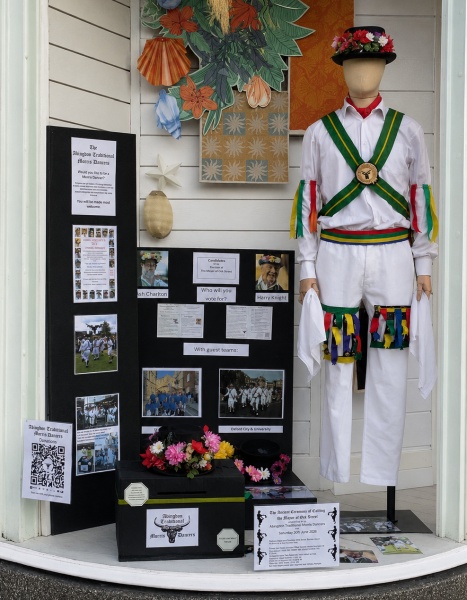
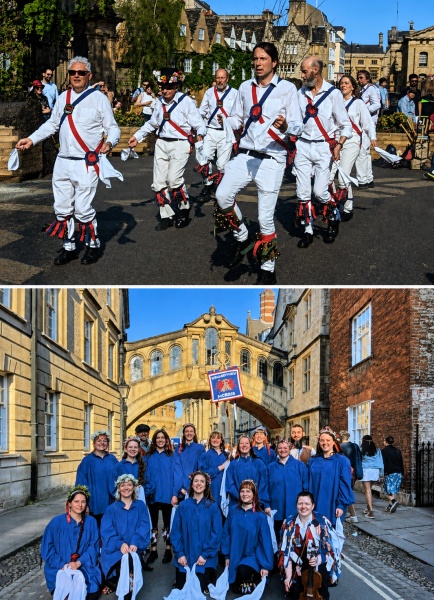
Heritage Open Days returned to Abingdon this weekend, with Saturday as the main day of events. This year’s national theme was architecture, and many local organisations opened their doors to show off Abingdon’s historic buildings. In the Market Place there was a Heritage Open Day stall providing maps and guidebooks for visitors, along with entertainment from The Abingdon Traditional Morris Dancers.

The event attracted people from far beyond Oxfordshire – even from as far away as New Zealand. These visitors were photographed in the Guildhall.

The Mayor of Abingdon, Cllr Rawda Jehanli, toured the exhibitions, pictured here with two of the event organisers who were showing her round.

At Trinity Church, welcomers greeted people and answered questions.

There was also a friendly welcome at St Helen’s Church, where among other things was an old parchment tithe map from 1842.

The Abbey Buildings go even further back and hosted re-enactors dressed as Roman citizens, bringing the era to life.

A couple of soldiers were recovering after a re-enactment battle. They had one at 11 am and one at 2 pm.

As part of Heritage Open Days, the Abingdon Artists ran their Landscape in a Day event, with artists painting views of the town’s buildings and streets.

Some venues were especially popular. The tours of the Sophos building were fully booked when I applied.

I was, however, able to visit the Old Gaol Atrium, a space that combines the historical with modern glass and concrete.

I also explored the offices of West Waddy, the local architecture firm based in a spectacular old building with views of the River Thames. The day was mostly sunny but there were some cracks of thunder and occasional showers.

Heritage Open Days carry on tomorrow, Sunday, with more walks, exhibitions, and hidden corners of Abingdon to explore.