Didcot Rangers without Rangerettes

Rangers no Rangerettes
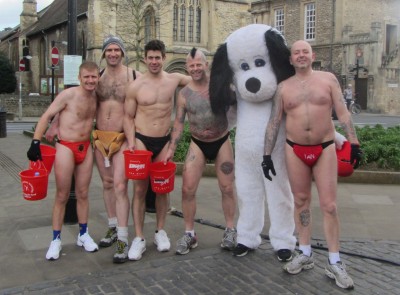
A group of scantily clad young men came through town on Saturday collecting money for one of their good causes. Last time I pictured the Didcot Thong Rangers in Abingdon it was back in November 2008 when they were pulling a truck for Breast Cancer research. This time they are raising money to help a baby with Meningitis. With them were some young ladies on roller scates – the Rangerettes – on a 16 Mile Rollerskating Challenge Didcot-Abingdon-Didcot. I was too slow to catch the Rangerettes.

Taking steps for Fairtrade in Abingdon

Fairtrade Market
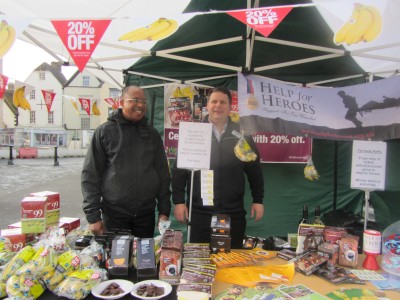
The first Market Place event of the year was a Fairtrade market. Waitrose were there showing a range of their products and offering free samples.
Fairtrade Market
The Co-op were there selling Fair Trade products like 99 Tea with 20% off.
Fairtrade Market
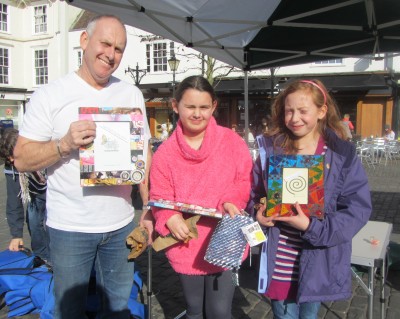
Skinny Hippo were there with some of their Fairtrade craft products.
Fairtrade Market
The Mayor received a certificate to say that Abingdon is officially recognised as a Fairtrade town.
Fairtrade Market
We are currently into Fairtrade fortnight and  there is a national event called “Take a Step in Fairtrade fortnight (Feb 27th – March 11th). You can register a step if you like at online.

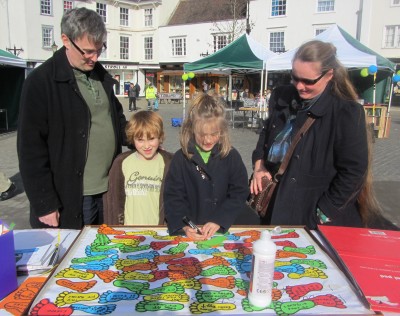
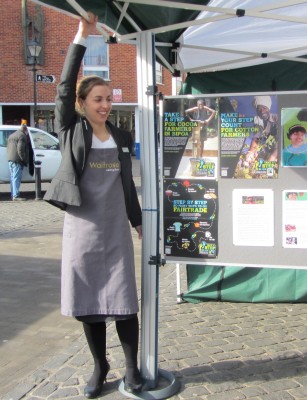
About 60 Abingdon people wrote the Step they are going to take for Fairtrade on a board on the Market Place. This young lady is going to try to find Fairtrade Ice Cream.

“Fairtrade is about better prices, decent working conditions, local sustainability, and fair terms of trade for farmers and workers in the developing world.”

Abingdon links in London – 3. Statue of St Edmund Rich of Abingdon

Millwall and St Edmund
After work today I went sightseeing in Millwall.

Millwall is best known to me at least for the Football Club, Millwall F.C. who now play in Bermondsey and have not played in Millwall for some time.

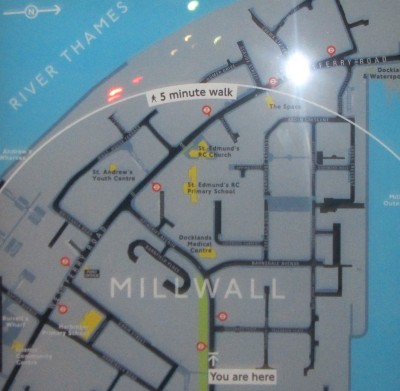
But if you look on the bus map of Millwall above, you will see the purpose of my visit – to view St Edmund’s School and Church, and a statue – in honour of St Edmund Rich of Abingdon.
Millwall and St Edmund
My first view of the church was a little disconcerting. The notice on the property alongside says “DANGER – ANTI CLIMBING DEVICE – Treated with Anthrax.” Then I read the small print … “and a dose of British sense of humour.”
Millwall and St Edmund
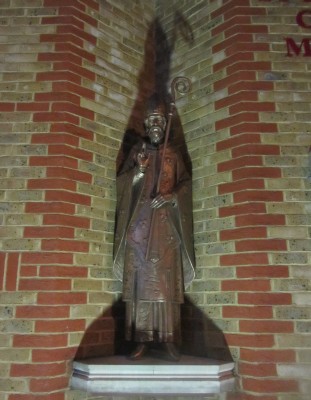
I am not sure how a church in Millwall, Isle of Dogs, London has managed to get such a superb memorial to St Edmund of Abingdon.

A church called St Edmund’s was opened in Millwall in August 1875, replacing a church called St Edward’s.
Millwall and St Edmund
The current building looks a far more recent addition. So having done my sight seeing and not been able to explain the association with St Edmund of Abingdon I returned to Mudchute Station on the The Docklands Light Railway to return from whence I came. By the way – the Mudchute in question was a huge pile created when Millwall Dock was dug out in 1860.
Two Commemorative Plaques on the Fitzharry’s Estate

Hugh Fitzharry
Just off Bath Street, up Fitzharry’s Road, can be found a large green space in the centre of a 1950s estate. The estate was developed as housing for workers at the atomic energy research establishment in nearby Harwell.
Hugh Fitzharry
The green space with the plaque is what reamins of Fitzharry’s House – a large historic house demolished in the 1950s. It had a long history and The Friends of Abingdon tried to save it – but in vain.
Hugh Fitzharry
Nearby, close to the River Stert, is a similarly framed plaque. It describes the mound beyond –  which is the remaining half of what was once a Motte and Bailey. This fortification was constructed in  the years after the Norman Conquest when the new overlords could not always sleep soundly in their beds after fining and taxing locals above the odds
Hugh Fitzharry
The top of the Motte is ten to twelve strides across, and about ten strides deep. It is still surrounded by a ditch which was once the moat. The Bailey that stood on the Motte would not have withstood an attack by a visting army but would presumably have kept a marauding mob of locals at bay on a Friday night.

The Ftitzharry name comes from a 13th knight, Hugh FitzHarry, who sold this estate to Abingdon Abbey before going off to the crusades. He probably got bored of  fining locals whose pigs had strayed onto his estate, and got fired up by something really really worth fighting about – the Holy Land.  Nothing much has changed.