Abbey Buildings – £4 Million Restoration Grant Announced


An announcement was made today at the Abbey Buildings in Abingdon of the award of a £4 million grant from The National Lottery Heritage Fund. Pictured at the event are Felicity Dick, Deputy Lieutenant of Oxfordshire; Gregory Bensberg MBE, Chair of the Abingdon Abbey Buildings Trust; and Cllr Rawda Jehlani, Abingdon’s new Mayor, elected yesterday.

The grant will fund a three-year project to restore and modernise the 13th-century Grade I listed buildings – the Unicorn Theatre, Checker, Undercroft and Long Gallery – making them accessible and usable all year round. Plans include windows to fully weatherproof the Long Gallery, installing a lift, creating level floors, and enhancing facilities including a glass lobby, retractable seating, and disabled toilets in the Unicorn Theatre.

Gregory Bensberg said, ‘These buildings are part of Abingdon’s story and central to our community. Making sure that everyone can access these, all year round, is the reason this project is needed.’

The Abbey Buildings Trust, formed from the Friends of Abingdon Civic Society, has already raised over £1.2 million from Abingdon-on-Thames Town Council, the Wolfson Foundation, the Historic Houses Foundation, the Pilgrim Trust and the Oxfordshire Buildings Trust and will now launch a public appeal to complete the funding. Works are hoped to begin in summer 2025.

Christian Aid at 80


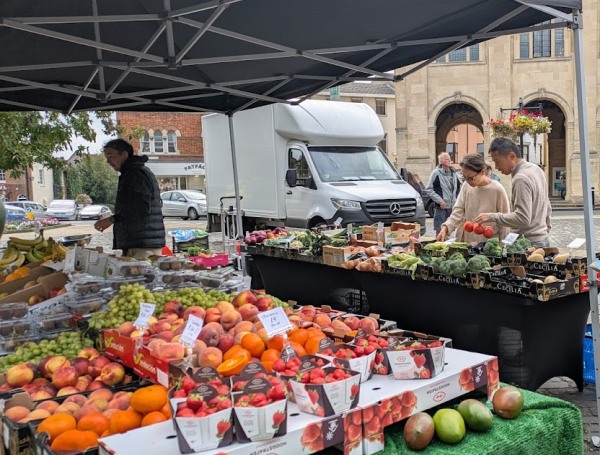
On Saturday, a Christian Aid stall was set up in Abingdon’s Market Place, marking the start of Christian Aid Week 2025.

Christian Aid was founded in 1945 as Christian Reconciliation in Europe, in response to the suffering caused by the Second World War. British and Irish churches came together to support refugees in urgent need. In 1957 they launched Christian Aid Week and in 1964 renamed the charity to Christian Aid.

Eighty years on, Christian Aid continues to work alongside communities around the world facing poverty, conflict, and climate crises.

Twenty years ago, most households in Abingdon received a distinctive stick-down Christian Aid envelope, collected door to door by volunteers. That tradition is less common, but fundraising continues in new ways such as online envelopes.

The Abingdon Christian Aid Group’s online envelopes for 2025 is at https://fundraise.christianaid.org.uk/envelope-2025/abingdons-envelope.

VE80 – MGs on the Market Place


Abingdon marked the 80th anniversary of Victory in Europe (VE80) with a display of classic MG cars on the Market Place. Alongside the cars, an exhibition told the story of how the MG factory in Abingdon helped the war effort during World War II.

When the war began, MG stopped making cars. Instead, the factory’s workers turned their skills to wartime production. They repaired armoured vehicles and built Crusader tanks. They also made engine parts for Lancaster bombers, wing sections for Tempest fighter planes, and other aircraft parts—such as units for Albemarle aircraft and panels for Hawker Typhoons.

One of the MG cars on display, a Magnette, had a special passenger: an 80 year old, soft toy duck called Quackers. Quackers was made during the war by the car owner’s Uncle Harry, who was seriously wounded in Italy and lost the use of his right hand. As part of his recovery, he taught himself to knit with his left hand and made Quackers who has stayed with the family ever since.

The Mayor of Abingdon, Councillor Gabby Barody, visited the display and spoke with the organisers. It is likely to be her final event as Mayor, as the town council will elect a new Mayor tomorrow.

P.S. This is the display currently at the bottom of Stratton Way. Thanks to Abingdon-on-Thames Town Council.

This Weekend at the Royal British Legion, Abingdon: “Overlord” Model Railway Layout


This weekend, visitors to the Royal British Legion in Abingdon can view the impressive “Overlord” model railway layout, created by Chris Mead. Transported from Wakefield, the layout is so large that it has to be displayed in two sections to fit the available space.

“Overlord” depicts a busy dockside scene, inspired by the wartime ports of Southampton and Portsmouth. Grey naval ships — landing craft and destroyers — are moored in resin water. On the quayside, military trains connect the docks to the inland supply routes, while tanks and troops prepare for embarkation.

The layout represents the build-up to Operation Overlord, the Allied invasion of Normandy in June 1944. Among the many details are a captured German U-boat repurposed by the Allies, the PLUTO pipeline (used to supply fuel across the Channel), and sections of the floating Mulberry harbours that were vital to the landings.

This video gives a tour first of the Royal British Legion club with bunting and poppies and then the railway layout: