Redevelopment between Stert Street and Queen Street


The redevelopment of No. 22 Stert Street and No. 20 Queen Street, behind, is progressing. The shop at No. 22 Stert Street has been completed since August 2023 and occupied by a barber, while the remainder of the development has been ongoing.

No. 20 Queen Street previously housed a butcher’s on the ground floor and a gym on the first floor.

During the last couple of days, the medieval-style passageway through Queen Street has been temporarily closed to allow for the installation of underground services.

Most of the existing buildings have been converted into flats, with additional flats and solar panels added above the old roof.

Petrol Price Uniformity

I more often write about petrol prices when they’re volatile and hit new highs. But this time, the question is why are all the service stations in Abingdon charging almost exactly the same price for unleaded?

For years, a certain supermarket, let us call them T, in Abingdon was the place to go for the cheapest petrol in town. That’s no longer the case. A recent snapshot (February 21st, 2025) reveals a surprising uniformity.

T now matches the Vineyard petrol station, which used to be more expensive.

And T is 0.2p per litre more expensive than the Esso station on Marcham Road, a station that used to be pricier.

T in Abingdon appears to be the most expensive T petrol station in Oxfordshire. Here’s a comparison:

Unleaded Prices on 21/2/2025:
T Abingdon: 141.9p
T Banbury: 137.9p
T Bicester: 137.9p
T Didcot: 137.9p
T Oxford: 139.9p

A look at Didcot, a town with more supermarkets and other petrol stations, reveals a wider price range – from 136.9p to 142.9p. T in Didcot prices its unleaded at 137.9p. Are T using a location-based pricing strategy? Instead of setting uniform prices across the county, and undercutting local competitors as they have done in the past, they now seem to be aligning their prices with the local market.

Figures come from https://www.petrolprices.com/.

What’s On in Abingdon – Clubs, Comics, Model Railways & Wildlife


If you’re looking for things to do in Abingdon, the library is a good place to start. Their A-boards noticeboards, and information boards are spilling over with half-term activities and local events.

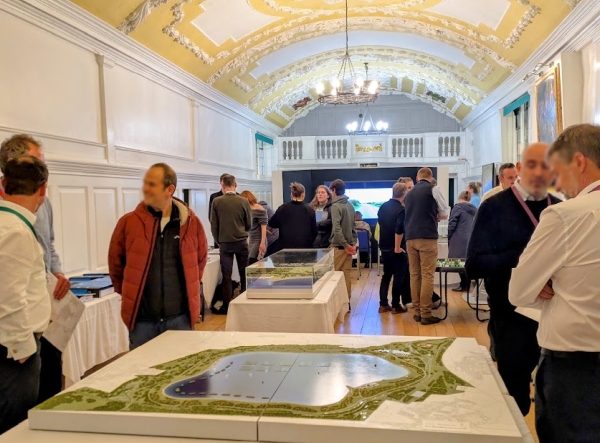
One event missing from the library’s noticeboards (at least, for now) is the Clubs and Societies Day on March 1st at the Guildhall, hosted by Abingdon-on-Thames Town Council. Whether you’re looking to join a local group or curious about what’s happening in town, this is a good place to start.

As part of their author series, Abingdon Library is hosting comic book writer Tom Wilkins and illustrator Louis Williams, whose work blends mythology with strong storytelling.

The annual exhibition by Abingdon & District Model Railway Club, returns on Saturday 1st and Sunday 2nd March at Abingdon & Witney College, with 35+ layouts, 12+ traders, and live demonstrations.

Interested in helping local wildlife? A talk on Oxfordshire’s Local Nature Recovery Strategy will explore how to improve biodiversity — from small changes in the garden to wider community action.

The Abingdon Sword: A Saxon Legacy in Oxford and Abingdon


In 865 AD, a Danish army arrived in Britain, sweeping through the north and leaving destruction in its wake. As they advanced south, Abingdon Abbey was burned to the ground. An artifact from around that time is a decorated Saxon sword known as the Abingdon Sword.

Currently displayed in the Ashmolean Museum in Oxford on Level 2 (Gallery 41: England 400–1600), among the late Saxon artifacts, the Abingdon Sword is a fine example of Anglo-Saxon craftsmanship. The label says:

100. Sword, iron and silver. c. 875, Abingdon, Oxfordshire. The blade of the ‘Abingdon Sword’ was produced through a process known as pattern welding, in which strips of iron were twisted together and welded into a pattern that gave the blade added strength. (AN1890.14)

The sword was discovered near Abingdon in 1874 and later acquired by the antiquarian Sir John Evans, who presented it to the Ashmolean in 1890. The Ashmolean holds many artifacts from Abingdon, though few are currently on display. They can be seen online through the museum’s digital collections. Just search ‘Abingdon’.

For those interested in seeing Anglo-Saxon history up close, a visit to Abingdon Museum is worth the climb if you’re able. A replica of the Abingdon Sword is on display. The museum also has a  display case, along with two drawers of Anglo-Saxon artifacts.

One of the most significant discoveries in Abingdon was the large Anglo-Saxon cemetery uncovered in 1934 during the construction of Saxton Road. This burial site revealed many inhumations and cremations, accompanied by grave goods such as weapons, tools, and jewellery.