Category Archives: heritage

Abingdon links in London – 1. St Mary Abbots

raffle prizes
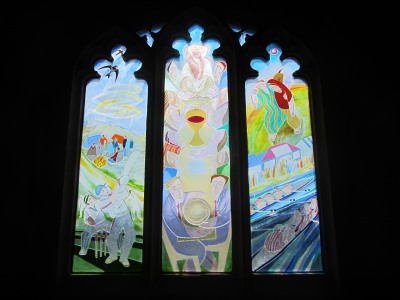
For a few weeks I’m working within sound of Bow Bells, and have started to seek out places in London associated with Abingdon. First place I found is the church of St Mary Abbots …

A noble knight who was given lands in Kensington (after 1066 and all that) had a son who was taken seriously ill. Faritius, Abbot of the Abbey of St Mary at Abingdon, helped cure the boy, and as a result the grateful knight bequeathed the church in Kensington, and much land, to the abbey.

Abingdon Abbey established a parish in Kensington, dedicated to St Mary. The church, opposite Kensington High Street Tube Station, has been rebuilt since, but is still called St Mary Abbots – the ‘Abbots’ being in memory of Faritius and his successors. I believe it has the tallest steeple in London at 278 feet.  (Trinity in Abingdon is 128 feet. Not sure about St Helens.)

Concerning our exaggerated gables

Back Street
The History of Abingdon by James Townsend was published in 1910 and the final chapter STREETS AND HOUSES describes East and West St Helen’s Street.
Back Street
… East and West St. Helen’s Streets with their exaggerated gables retain something of their mediaeval aspect. ‘Westseynteleynstret’ appears in 1375, ‘Seynteeleynstret’ in 1404, and ‘Estseyntelynstrete’ in 1405 in the Account-rolls.
Back Street
Fore Street and Back Street are names still in use for East and West St. Helen’s respectively.”

A hundred years after Townsend’s book, the overnight snow might give the streets back a more mediaeval aspect if it were not for the cars, street lamps, and pavement barriers. The houses in both streets still retain their exaggerated gables – even some of the modern ones – like ours.

The Old Mayor’s House – from back to front

The Old Mayor's House
I often pass these flats and read the two large address plates on the back saying that this is “The Old Mayor’s House”.

Today I read about that building in Historic Abingdon, Fifty-six articles by Agnes C  Baker. On the 18th April 1952 she wrote  “The house breakers are at work in Abingdon … at No 9, High Street … workmen hurl down masonry … just as close on 400 years ago the house was build.”

Number 9, The High Street, was once the house of Richard Mayott, the first Mayor of Abingdon –  1556. He was also Mayor 1568-69, and for the third time in 1578, during which time he died.

Miss Baker writes that elaborate carving have been discovered on the back of one stone fireplace, and says that people conjecture that the stone is from Abingdon Abbey.
The Old Mayor's House
Back then the building was being rebuilt to provide better premises for the Co-operative Society.

That same shop is currently To Let. Two letting agents seem to be involved – one of whose sign fell down at the end of November, and is still to be seen in a heap on the ground.

Lift dig discovery?

Diggings
Peering into the hole, you can see how our fine County Hall is balanced on rubble foundations.

Also looking into the lift hole there appear to be areas that are now being more carefully dug out. It could be that the the archaeologists have been called in to investigate – possibly a Roman ditch.