Category Archives: heritage

11th January 1645 – Civil War – Abingdon

Thank you to Mark Turnbull for this piece. All Rights Reserved. Three of the pictures were taken in 2019 at an English Civil War Society re-enactment in Gloucester. The last picture was taken during Abingdon Heritage Open Day 2013 at Culham Bridge.
Civil War - Abingdon
On 11th January 1645 troops commanded by King Charles I’s nephew, Rupert of the Rhine, appeared before Abingdon intent upon seizing it. During the endgame of the British Civil War, the fate of the town was the focus of a desperate and most remarkable struggle that is preserved in a series of letters. Abingdon’s fate caused royalist in-fighting that succeeded only in wounding the King’s cause.

Four months earlier on 14th September 1644, Rupert’s bitter rival, Lord George Digby opened rapid fire correspondence with Parliament’s governor of Abingdon, Major-General Richard Browne. The toxic Digby may have had golden curls and a politician’s silver tongue, but he certainly didn’t have the Midas touch. Considering Abingdon’s garrison were mutinous over pay, he’d assumed it to be ripe for the picking and coaxed Browne to turn coat.

Lord Digby’s courting quill flattered, fawned and offered rewards a-plenty. There was a baronetcy, continued governorship of Abingdon once in royalist hands, and command of a brigade in the King’s army. Digby even offered Browne, “what other reward you shall desire within His Majesty’s power to grant.” Notwithstanding this bait, Browne stood firm, but cunningly offered lip service to the plot. Rupert, meanwhile, advocated an attack but was muzzled by the royalist council. All that marched forth was time itself.
Civil War - Abingdon
Digby resorted to tittle tattle in an effort to alienate Browne from his colleagues; Sir William Waller had supposedly spoken to the Countess of Brentford of the, “rogue Browne, who would use her like a clown.” Digby also promised to send on, “Lord Saye’s letter written with his own hand, whereby you may guess at your future respects with [Parliament].”

The end of November marked ten fruitless weeks, yet still Digby reloaded his ink time and again. On 1st December he pushed for action with an idle threat, “it would be an extreme grief to me, to be an occasion of misfortune to you.”

Having staked his reputation and assured the King of his success, the deluded Digby couldn’t contemplate failure. He even betrayed the intentions of the King’s army. “The pressures of our military men here for some enterprise, either for the taking or blocking up of [Abingdon], are daily such as I suffer much by opposing them.”

Communications between the two pen-pals was to get more explosive. Warning signs such as Parliament sending fifteen-hundred reinforcements to Abingdon failed to dim the blue skies of Digby’s world. Only on 19th December did Browne admit that his, “design was to play with you at your own game, till our works … were strengthened and accommodated with men and provisions …”
Civil War - Abingdon
Digby threatened to publish the letters to prove Browne’s prostitution of himself. Unbelievably, he also persisted and suggested Browne might follow through once royalist troops approach the town. But Browne, acting fast and acting first, published all of these fascinating and insightful letters and saved this chapter in Abingdon’s history for posterity.

One of Browne’s last letters must have galled Digby. “I find you are swelled, and the poison you vent is worse than spiders; but your web is so thin, that the readers will guess by the ridiculousness of your plot.” Browne continued, “If I were a prostitute, my lord, as you call me, why did your honour act the pimp, and offer me a reward with such solicitations so frequently, so hotly, so long a while?”

At this juncture, Rupert and the army were finally let loose upon the by now strengthened defences of Abingdon, and the reinforced Parliamentarians manning them. In the early hours of 11th January 1645, three-thousand royalists were on Culham Hill. An attack was made at Culham Bridge and all went well until Browne’s men waded through waterlogged meadows and outflanked Rupert’s. The Parliamentarians attacked the royalist rear and forced them to withdraw, trapping some on the bridge. Sir Henry Gage, one of the King’s most able commanders, was killed and in obeyance of Parliament’s orders, Browne mercilessly hung all Irish prisoners. The royalist humiliation over Abingdon was an open wound. After only two months as General of the King’s armies, Rupert’s command had been neutered by politicians playing at toy soldiers.
Civil War - Abingdon
Mark Turnbull is the author of an award-winning civil war novel called Allegiance of Blood, set in 1642-43. More information can be found at www.allegianceofblood.com

Star Tavern – excellent supper

A Star for Epiphany
On 24th April 1847 the Oxford Chronicle and Reading Gazette reported “The Mayor’s Court Leet Jury inspected the weights at the shops and warehouses of the various tradesmen in Abingdon, which, with a few exceptions, were found correct.

In the evening the jury and a party of friends partook of an excellent supper at Mr. Joseph Emmens’s, the Star Tavern. The health ot his worship, the Mayor was drank in a bumper.”

Mr Emmen managed the Star Tavern from some time before 1823 to some time after 1854, according to Kelly’s Directories in Abingdon Library. The Star Tavern also functioned as a tobacconist and hairdresser. (Picture is part of a 1857 Print by John S Austin – Oxford Architect – All Rights Reserved.)
A Star for Epiphany
If the Star Tavern was still standing today it would be in front of the DaleBoot UK sign and entrance, and would hide the view of the TSB.

According to Abingdon Borough records from 1888, trees were planted where the Star Tavern had stood. The Star, and the pub over the road, had been demolished to allow Stert Street to be widened into a main road.

* Epiphany is celebrated 12 days after Christmas on 6th January and remembers the arrival of the wise men, who followed the star to find Jesus. Why I did a blog post about a lost Abingdon star.
* Court Leet was a court for small offences. Such courts went on to check standards in sales of food and drink.

Thankyou to The british newspaper archive for the news story about the Star Tavern.

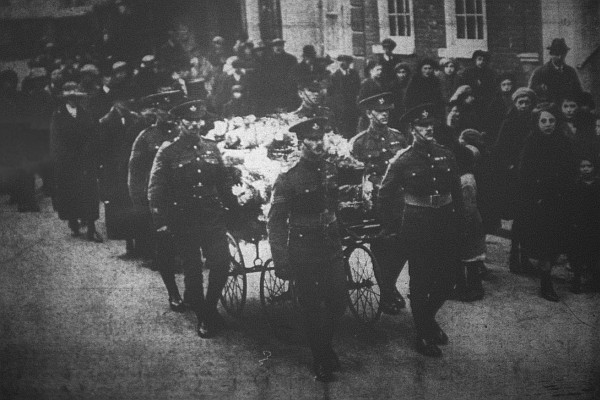
Abingdon 100 years ago – December 1919

Abingdon 100 years ago
Saturday 6th December 1919

A bachelor’s dance was held in the Abingdon Council Chamber on Wednesday evening, when there were nearly 120 present. The Oxford Prize Band supplied the music.

A confirmation was held at St. Helen’s Church, Abingdon, on Sunday afternoon with the new Bishop of Oxford, when the candidates numbered 120, 91 of which were from Abingdon.

A lecture on the Life of Livingstone, with lantern slide illustrations, was held in the Wesleyan Schoolroom on Wednesday evening in last week.

A steam lorry was being driven back to Milton Depot by William Russell, of Reading, when, in Ock Street, Abingdon, in consequence of the gearing it swerved and collided with a cottage, in the occupation of Mr H. Church, knocking the door down and part of the wall.

An inquest was held at Abingdon Police Station on Thursday last by Mr Bromley Challenor, on the death of Jeffrey Brightman, aged 2 years, the child of an ex soldier, Benjamin Brightman, of 7, Gaol Yard. Abingdon, who died on the previous Tuesday through being scalded. The evidence went to show that the mother placed a small bath of hot water on the floor down stairs, and whilst fetching some cold water the deceased fell into the bath and was severely scalded. The child was taken to the Cottage Hospital, where the injuries were attended to, and was brought back home, where he died the following day.
Abingdon 100 years ago
Saturday 13th December 1919

Abingdon has contributed by collections the sum of £l8 10s 7d to the National Home and Orphanage Fund, as this years effort.

The Abingdon Municipal Charity Trustees are distributing from Robert Mayott’s Charity, six overcoats to elderly men, and eight gowns to elderly women, residents of the Borough.

The Guild of the Abingdon Wesleyan Church held a pleasant social evening on Wednesday last week, when the programme included impromptu speaking efforts and games.

A memorial service for the late Mr J. H. Broxup, late headmaster of the Abingdon Council Schools, was held in the Abingdon Trinity Wesleyan Church on Sunday evening last, when there was a large congregation. including many old boys of the Abingdon British Schools, of which he was formerly headmaster, and also past and present scholars of the Council Schools.

In aid of the Abingdon Sanatorium Comforts Fund a very successful subscription dance was held last week in the Abingdon Council Chamber, when nearly 150 were present. Supper was provided by friends, and a substantial sum was raised.
Abingdon 100 years ago
Saturday 20th December 1919
A League match was played at Abingdon, on Saturday, between Abingdon Town and Abingdon Pavlova Club, Abingdon Town winning by three goals to nil. There were, as usual at these matches, many local spectators, and considerable enthusiasm was shown in the game.

The Abingdon Bowling Club are being provided with two more greens in the centre of the Albert Park, the property of Christ Hospital Governors.

The Abingdon Comrades of the Great War held another successful whist drive at their Club Rooms, Ock Street, on Thursday evening last, when nearly 100 were present Six prizes were given by Mrs Councillor Reynolds, and two rabbits by a local farmer.

The only case at this Borough Court on Tuesday last before the Mayor and Mr J. Paul, was M A. Cox. schoolmistress, Ock Street, fined 4s for chimney on fire.

Among the goods found in possession of Bertha Hambleton, (34). 9, Aston Street, Oxford, and Alice Dunton, (24), 17, Field Road, Reading, arrested and charged at Banbury Petty Sessions last week, were found several articles taken from the shops of Messrs Viney, Bros, drapers, Market place, and Madam Lyalls, costumier, High Street, Abingdon.
Abingdon 100 years ago
Saturday 27th December 1919
On Boxing Bay, in very wet weather, a match was played on the Abingdon ground between Abingdon and the Oxford United Trades for the War Memorial Cup, when the score was Abingdon 5, Oxford 0.

A carol service was held on Sunday evening at the Congregational Church from 8 to 9 o’clock. Miss Luker sang ‘The Star of Bethlehem’ and Mrs Pearson, ‘See, Amid the Winter Snow,’ and the special carol issued by St Dunstan’s, entitled, ‘They gave their sight,’ was rendered by the choir. The collection on behalf of blinded soldiers and sailors amounted to £3 5s.

The Abingdon Pavlova Leather Works employees and friends had a large Christmas party at the works. Spring Road. Abingdon, on Saturday, which took the form of a fancy dress ball. One of the large warehouses was decorated profusely for the occasion, and about 600 were present. Prizes were given for the best costume characters.

Abingdon 100 years ago
Saturday 3rd January 1920

St Helen’s bells rang the Old Year out and the New Year in. A devotional service was held at St. Nicolas’ Church at 10 o’clock, and an hour later there was a watch night service in the Wesleyan Schoolroom for the Free Churches.

Thankyou for the extracts to the Faringdon Advertiser and Vale of the White Horse Gazette on the British Newspaper Archive. Abingdon adverts came from the North Berks Herald and Save the Children and Great Ormond Street from a national paper. The Happy Year 1920 picture was made using a film still from the 1920 era with snowflakes and title added.

Book Launch – Radley Manor and Village

Radley Manor and Village
Yesterday was the launch of a new local history book: RADLEY MANOR AND VILLAGE: a thousand year story.

Radley is very close to Abingdon. The land did once belong to Abingdon Abbey. After Henry VIII dissolved Abingdon Abbey, Radley Manor became separate.

In more recent times, as Abingdon has expanded as a town, fields that were parts of the parish of Radley have become estates in Abingdon.
Radley Manor and Village
The location of the launch was The Mansion, Radley College.
Radley Manor and Village
The book is a collaboration between Radley History Club and Radley College. The book tells the history of Radley’s manor and its relationship with the village from around the time of the Norman Conquest to the present day.

The College was started in 1847 on land owned by the Bowyer Family, who owned the Manor. The College came to own more and more of the land, and now covers 800 acres.
Radley Manor and Village
At the launch there was an interesting storyboard history of the estate. Radley WI were serving refreshments.

Outside in the college grounds there were many rugby players getting ready for an afternoon of training and sport.