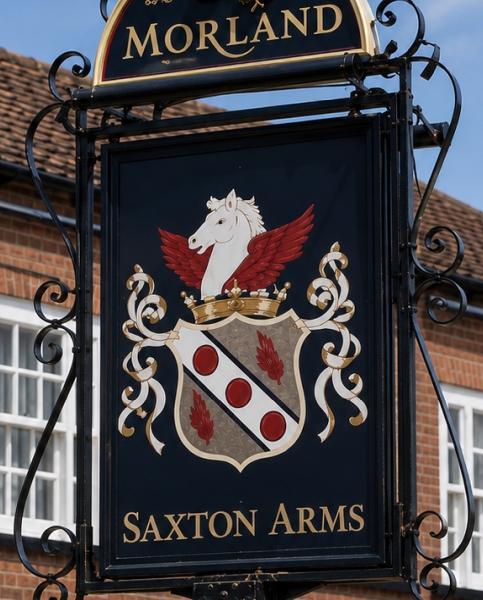
The Saxton Family made a big contribution to Abingdon during the eighteenth and early nineteenth centuries. The Saxton family’s contribution to Abingdon is remembered today through one of Abingdon most famous roads, Saxton Road, where the pub used to display their coat of arms. They also donated two famous royal portraits to the town, and held some distinguished positions in the town.
The family’s association with Abingdon began with Edward Saxton, a merchant and distiller, who was elected Mayor of Abingdon in 1730. (ref 1)
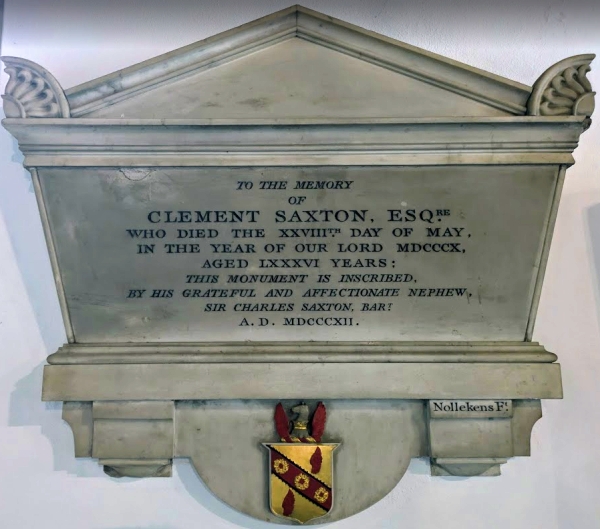
Edward’s eldest son, Clement Saxton (1724–1810), was educated at Abingdon School and enjoyed a distinguished military career in the Berkshire Militia. He served as High Sheriff of Berkshire in 1777, lived at Caldicott (now called Caldecott), supported Abingdon School as a benefactor, and is commemorated with a plaque in St Helen’s Church. (ref 2)
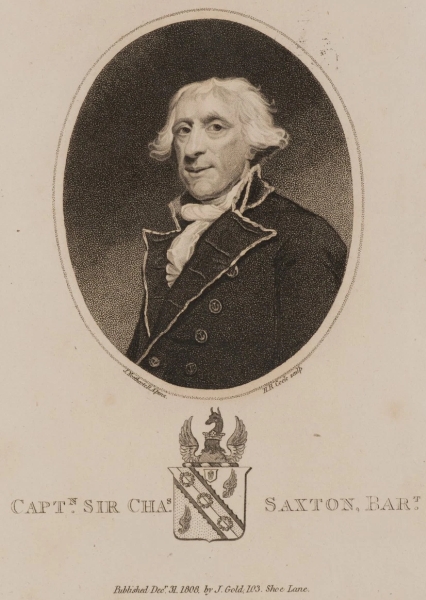
His younger brother, Sir Charles Saxton, 1st Baronet (1732–1808), entered the Royal Navy and after captaining various ships became Commissioner of His Majesty’s Dockyard at Portsmouth. In recognition of his public service he was created Baronet of Circourt in 1794. (ref 3)
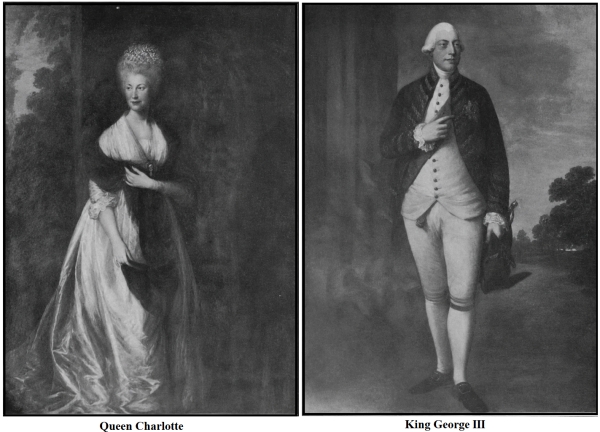
One of his gifts to Abingdon is recorded in the Oxford Journal (18 June 1808): “… full-length original portraits’ of the King and Queen have been presented to the Corporation of Abingdon, by Sir Charles Saxton, Baronet, whose son is Recorder of that town. These valuable pictures have been put up in the Council Chamber…” (ref 4)
The portraits of King George III and Queen Charlotte, partly attributed to Thomas Gainsborough, remain among the town’s most important paintings and are still displayed in the council chamber over 200 years later.
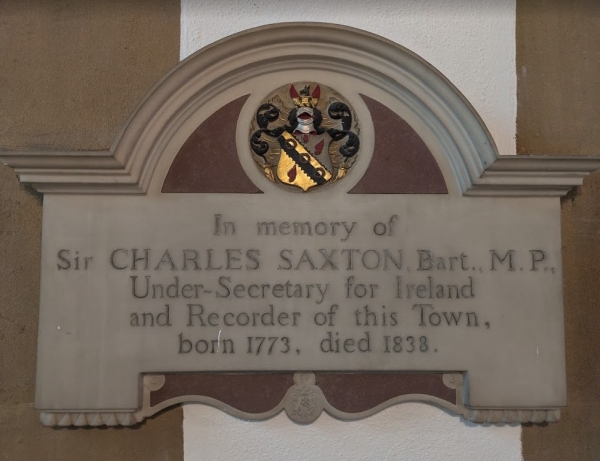
The donor’s son, Sir Charles Saxton, 2nd Baronet (1773–1838), also has a plaque in St Helen’s Church. He qualified as a barrister and became Recorder of Abingdon (the town’s chief legal officer) from 1805 until 1819. He entered government service in Ireland, becoming Civil Under-Secretary to the Lord Lieutenant. In 1812 he was elected to Parliament for Cashel (County Tipperary, Ireland), which he served until 1818. He later served as High Sheriff of Berkshire in 1824–25 and died at Caldecott House in 1838. (ref 3, ref 5)
References
1. Abingdon-on-Thames Town Council. Mayors of Abingdon since 1556.
https://www.abingdon.gov.uk/town-council/your-mayor/mayors-abingdon-thames-1556
2. Hammond, Nigel. Stewards(1743–1822) and Presidents (1893–2009) of the Old Abingdonian Club. Abingdon School Archive uploaded 2020 (original article 2008) p. 8.
https://archives.abingdon.org.uk/wp-content/uploads/2020/03/Hammond-stewards-presidents-part-1.pdf
3. Cokayne, George Edward. The Complete Baronetage, Vol. V. Exeter: W. Pollard & Co., 1900, pp. 287–289 (“Saxton of Circourt”).
https://archive.org/details/completebaroneta05coka/page/288/mode/2up
4. Oxford Journal, Saturday 18 June 1808, p. 3.
5. Jupp, P. J. “SAXTON, Sir Charles, 2nd Bt. (1773–1838), of Circourt, Berks.” The History of Parliament: The House of Commons 1790–1820.
https://www.historyofparliamentonline.org/volume/1790-1820/member/saxton-sir-charles-1773-1838
Thank you, Backstreeter, for the info about the Saxton family. I didn’t know anything about them.
Thanks from me too for a nice piece of serendipity. I meant to look up why Saxton Road was not called Saxon Road following your piece about the Anglo-Saxon cemetery a couple of days ago. All is now clear.