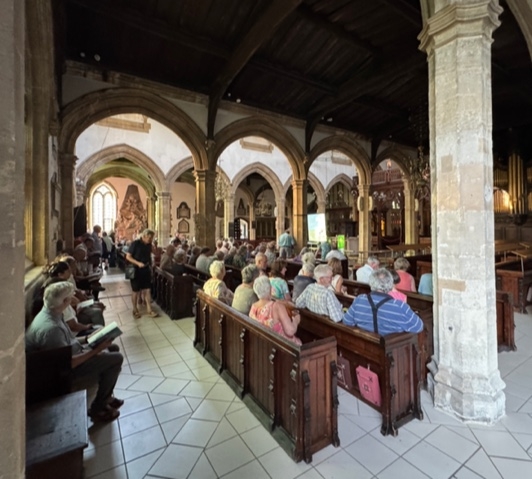
There was a good turnout at St Helen’s Church, Abingdon,
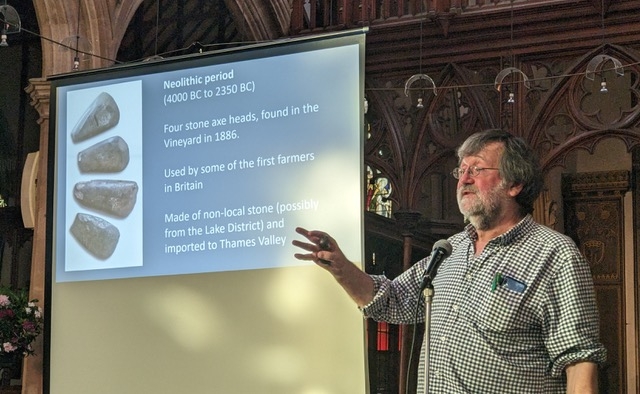
where archaeologist Roger Thomas gave a talk to mark the launch of his new book, England’s Oldest Town? The Archaeology of Abingdon,
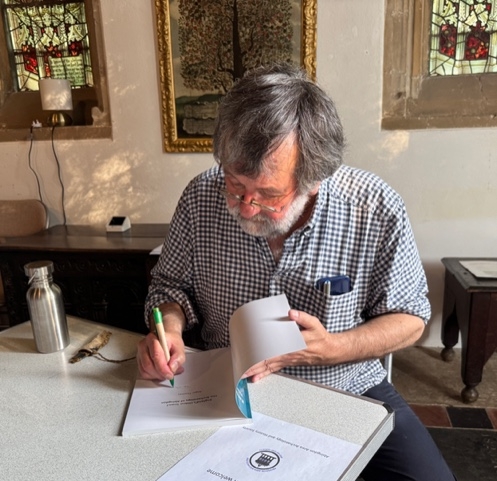
before signing copies for attendees.
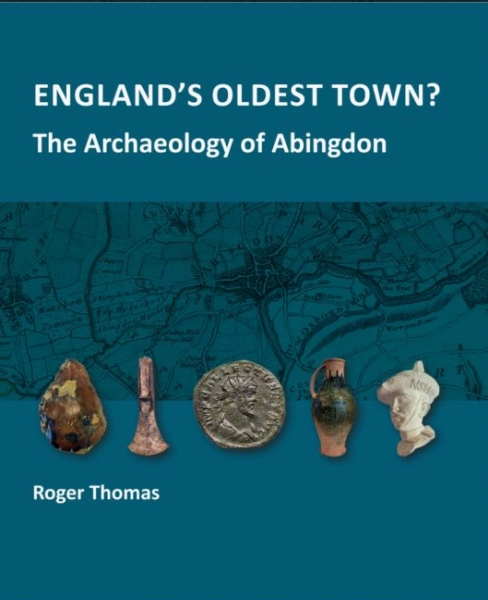
The book explores the archaeological discoveries that support Abingdon’s claim to be England’s oldest continuously inhabited town. It is now available from local bookshops and the Abingdon Museum.
Archaeological excavations beneath the town centre uncovered an Iron Age settlement dating back to around 300 BC, including round houses, storage pits and evidence of craft working. Together with evidence of continuous occupation through the Roman, Anglo-Saxon and medieval periods, these discoveries form the basis of Abingdon’s claim to be England’s oldest continuously inhabited town.
(Thankyou to Elizabeth for the pictures)
Amesbury in Wiltshire claims to have been a settlement since 8830 BC
But no evidence of continuous settlement
In 2014 archaeologists from the Universiry of Buckingham discovered that Amesbury has been continuosly occupied since 8820 BC (8830 BC, which l put in my first comment was incorrect).
The settlements are in and around Amesbury, mainly centred near Stonehenge. The University of Buckingham conclusion refers to ‘the area’.
Abingdon is England’s oldest continuously inhabited town, that is settled/lived in one place only. This is contested by some others, particularly Colchester.
Surely in and around Amesbury, includes Amesbury?