The Great Strike – First Two days in Abingdon
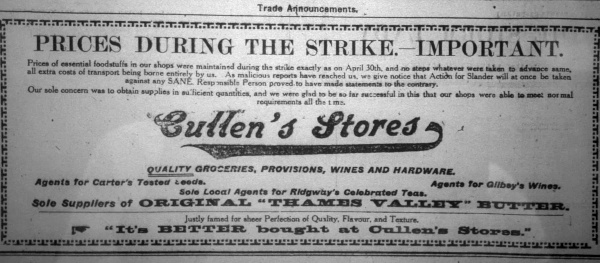
Abingdon was unusually quiet, with little traffic passing through the town. People employed in Oxford found there was no railway service, but were conveyed by motor bus instead.
The Mayor, Councillor J. D. Godfrey, called for the help of members of the council during the strike, and a joint food committee was set up for the Borough and District. Recruiting for Special Constables began at the Municipal Offices, where twenty-six names were handed in during the afternoon; the volunteers were sworn in the following day. The Mayor said that whatever people’s view on the strike, law and order must be maintained.
The gas works had a good stock of coal, and no men were on strike there, nor at the Electric Light Works. Bakers were being supplied with fuel by the local authority, and yeast had been obtained from London. Supplies at the coal merchants, however, were low, and households were limited to one cwt of coal per week.
Meanwhile, GWR men on strike at Didcot organised a cricket match, followed by a concert at the Red Triangle Club.
About forty men were laid off at the Concrete Brick and Tile Company in Abingdon because supplies of cement were unavailable. A restricted train service began between Abingdon and Radley.
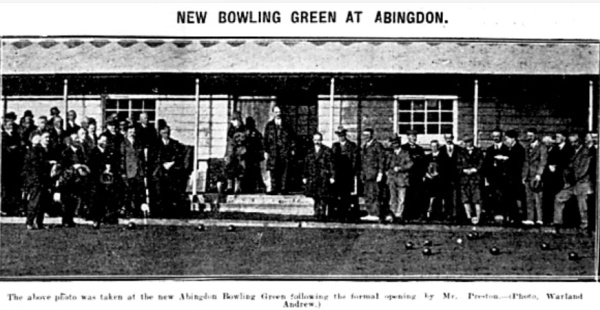
Abingdon Bowling Club – Opening of New Pavilion
The Great Strike did not interfere with the opening of the new pavilion of the Abingdon Bowling Club, and there were a large number of members and others present when Mrs. A. E. Preston declared the building open.
In asking Mrs. Preston, the wife of their president, to open their new club room, Mr. C. Johnson said it had been their ambition for many years to possess a home like that one. He claimed it would be an ornament to Abingdon Park and would be no discredit to the Borough of Abingdon.
The pavilion, which has cost over £200, has been built by money raised through loans, free of interest, entirely from the members, and has been built by Messrs. Blake Bros. of Abingdon.
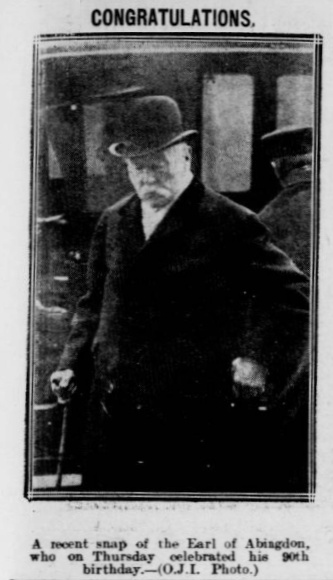
Congratulations to Lord Abingdon
A letter was sent by the Mayor and Corporation of Abingdon to the Lord High Steward of the Borough, the Earl of Abingdon. It read:
Dear Lord Abingdon –
The Corporation joins me in tendering the heartiest of greetings to you on attaining your ninetieth birthday.
We would couple with our congratulations the very sincere hope that a kindly Providence will continue to sustain you with health, happiness and peace, whereby you may be able to yet prolong your extended term of office as High Steward of the Borough.
Believe me, yours very truly,
JOHN DENNIS GODFREY
Mayor
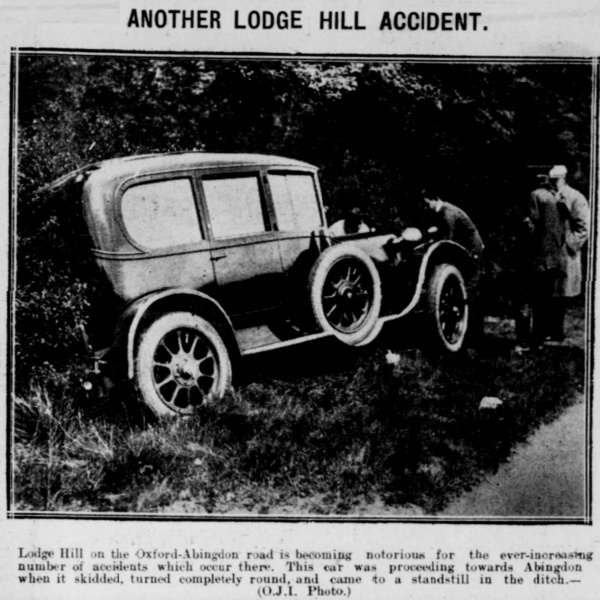
Another Lodge Hill Accident
The accidents that occur at Lodge Hill, the dangerous S-bend on the main road between Oxford and Abingdon, are becoming increasingly notorious. On Wednesday, there was yet another mishap at this spot, though fortunately no one was seriously injured.
Mr James Jacques, of Bournemouth, was driving home from Northampton when a lady cyclist riding ahead of him suddenly swerved. To avoid striking her, Mr Jacques steered off the road, resulting in an accident.
Strangled by Shirt Collar
The District Coroner, Mr Normley Challenor, held an inquest at the Chinese Camp, RAF Depot, Milton, into the death of Percy Picton, an Air Ministry warden.
Mr Picton had been seen the previous evening in good spirits and was described by one witness as a happy-go-lucky man. As he passed, he waved his hand, and called, “Hullo, Tom.”
The following morning, Mr Picton failed to report for duty at 6 a.m. A colleague went to awaken him and, looking through the window of his cubicle, saw him lying on his bed. There was no sign that anyone else had been in the room. The cubicle was locked and was opened using a spare key.
The deceased was fully dressed in uniform, apart from his jacket. Dr Richard Rice was summoned but found that the man was already dead. The deceased’s collar was fastened with a stud, and when it was released an indentation was revealed around his neck.
Dr Rice expressed the opinion that death was caused by asphyxiation resulting from pressure exerted by the shirt collar. The jury returned a verdict in accordance with the medical evidence.
Abingdon Man’s Death from Lockjaw
Walter William Stimpson, 26, of 7 St Helen’s Street, Abingdon, died in the Radcliffe Infirmary from tetanus after injuring a finger while engaged in pile-driving work at Iffley Lock.
An inquest heard that on May 10 he caught his hand between a pile and a “monkey”, the heavy weight used in pile-driving operations. After receiving treatment at the Radcliffe Infirmary and later attending Abingdon Cottage Hospital, his condition deteriorated. Dr Challenor ordered his removal to the Radcliffe Infirmary, where he died.
County Hall Repairs and Cemetery extension
At the Borough Council meeting on 28th May, a report was submitted that said repairs needed for the preservation of the County Hall estimated the cost as £2,000.
Consideration was also given to extending the cemetery. The council approved the acquisition of the necessary land and an application for a loan to cover the cost.
Acknowledgements
Thanks are due to the British Newspaper Archive for access to the Faringdon Advertiser and Vale of the White Horse Gazette. Additional thanks to the North Berks Herald microfilm in Abingdon Library for stories, and to the Oxford Journal in Oxford Library for the pictures. Also thankyou to the Borough Council Archives in the Library.