Category Archives: heritage

E R – in Abingdon

E R

At the back of the old post office there is the E R plaque.
E R
The ER letters also appear on most of our old post boxes – like this one pictured on Bath Street.
E R
ER (for Elizabeth Regina, Latin for “Queen Elizabeth”) also appeared regularly on stamps.

ER may not be used quite so regularly nowadays but 60 years have gone by since  Queen Elizabeth II came to the throne.

Abbey Mill Stream

Abbey Mill Stream
In the library I got one of the new leaflets describing the Abingdon Abbey information trail. The leaflet has a map, and descriptions of the locations of the 9 information boards.
Abbey Mill Stream
There is so much on each board that I find it better to visit one or two at a time to appreciate what they say. Part of the board near the bridge near the Abbey Gardens tells of the Abbey Fulling Mill – interesting to me at least as it makes a connection to a village I lived during my teenage years, where there was a fuller’s earth quarry.  Beating cloth in a solution of fuller’s earth ( a kind of clay) and urine removed natural greases so that the cloth could absorb coloured dyes
Abbey Mill Stream
The information board by Abingdon bridge also says that the millstream was constructed by Abbot Ethelwold in the 10th Century, and it led to arguments with other mill owners as it affected their flow. (Information on the boards was researched and compiled by Abingdon Area Archaeological and Historical Society.)
Abbey Mill Stream
Nowadays the channel is quite overgrown near where it flows from the Thames.
Abbey Mill Stream
There are a number of bridges across the stream, some well know…
Abbey Mill Stream
, and some off the main thoroughfare and less well known – like the one you cross to get to Cosener’s House..
Abbey Mill Stream
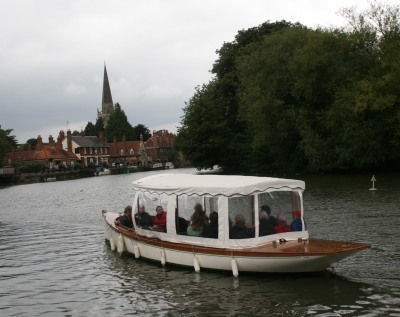
The mill stream emerges energetically from under the buildings near the Upper Reaches Hotel – who have restored a mill wheel to working order.
Abbey Mill Stream
The stream is joined by the River Stert, as it emerges from its culvert, at Abingdon Bridge before rejoining the River Thames.

Abingdon links in London – 1. St Mary Abbots

raffle prizes
For a few weeks I’m working within sound of Bow Bells, and have started to seek out places in London associated with Abingdon. First place I found is the church of St Mary Abbots …

A noble knight who was given lands in Kensington (after 1066 and all that) had a son who was taken seriously ill. Faritius, Abbot of the Abbey of St Mary at Abingdon, helped cure the boy, and as a result the grateful knight bequeathed the church in Kensington, and much land, to the abbey.

Abingdon Abbey established a parish in Kensington, dedicated to St Mary. The church, opposite Kensington High Street Tube Station, has been rebuilt since, but is still called St Mary Abbots – the ‘Abbots’ being in memory of Faritius and his successors. I believe it has the tallest steeple in London at 278 feet.  (Trinity in Abingdon is 128 feet. Not sure about St Helens.)

Concerning our exaggerated gables

Back Street
The History of Abingdon by James Townsend was published in 1910 and the final chapter STREETS AND HOUSES describes East and West St Helen’s Street.
Back Street
… East and West St. Helen’s Streets with their exaggerated gables retain something of their mediaeval aspect. ‘Westseynteleynstret’ appears in 1375, ‘Seynteeleynstret’ in 1404, and ‘Estseyntelynstrete’ in 1405 in the Account-rolls.
Back Street
Fore Street and Back Street are names still in use for East and West St. Helen’s respectively.”

A hundred years after Townsend’s book, the overnight snow might give the streets back a more mediaeval aspect if it were not for the cars, street lamps, and pavement barriers. The houses in both streets still retain their exaggerated gables – even some of the modern ones – like ours.