Thanks to Graham Looker who now lives at Quintrell Downs, nr. Newquay for this piece, that he did for a family history….
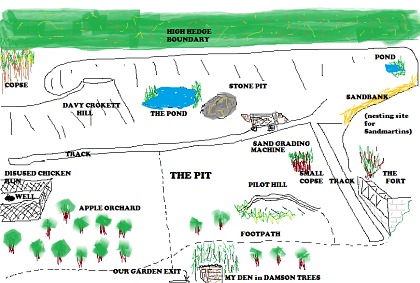
“The Pit” was at the rear of our bungalow at 111 Radley Road, Abingdon. Later the bungalow was renumbered to 127, but we never moved. “The Pit” was actually a small gravel pit which had been abandoned during the War I think. The period described here was roughly about 1954 to1960.
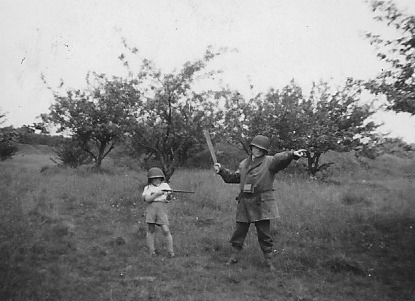
The owner was a Mr. Lacey-West who lived in Norman Avenue, quite a ‘posh’ road off of Radley Road. The CEO of MG cars, which were constructed in Abingdon then, lived in this road. His personal MG sported the number plate ‘MG 1’. We were well impressed!
Anyway, Mr. Lacey-West and his wife were quite elderly and the only interest they appeared to have in ‘The Pit’ was a small amount of cooking apple trees which were picked in season. At least, those which we hadn’t ‘scrumped’ previously.
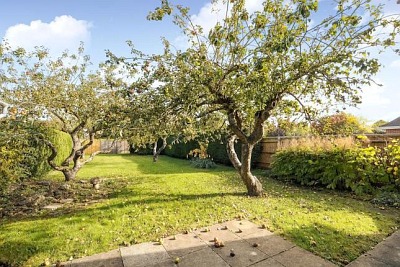
(Backstreeter: by the way Graham this is how one garden down Galley Fields looked recently – picture taken from an estate agents site.)
“The Pit” was everything a boy could wish for, it was like a natural Adventure Playground, and Mr. Lacey-West was quite amenable to us using it as such.
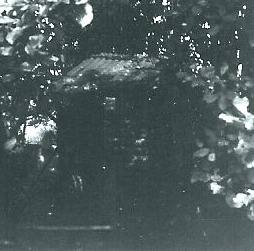
He even granted permission for my Dad to erect a small log cabin just inside the orchard, although it was actually surrounded by Damson trees. ‘The Den’ as we called it, was about five foot square. Simply made of four corner posts, with slats of pinewood with the bark still on the outside (obtained from the sawmill at Bagley Wood) and corrugated tin sheets for the roof, it was a real log cabin! Dad constructed a small door which we could lock, and we furnished it with metal drums to sit on and a little table. Outside we made a little fireplace and sometimes cooked small baked potatoes on and sausages, with damson’s for dessert! Later, we found some discarded roof tiles with which we lay on top of the corrugated tin, so that was good.
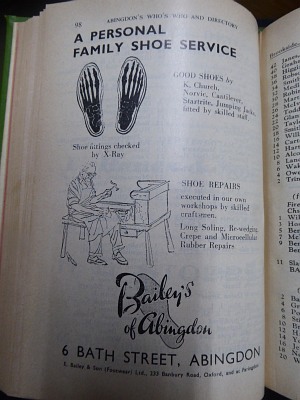
My friends around this time were Alan and Brice Gilmore, David Ashley (a Norman Avenue resident) Pat Carter, Noel and Nigel Preston-Jones, David Fowler and later Geoffrey ‘Froggy’ Bailey (another Norman Avenue resident, and his father owned Bailey’s shoe shop in town)
Mr. Lacey-West also appeared to have kept chickens in a large pen at one time, although it was derelict by the time I was old enough to discover it.
This site also included a covered well which we left alone, realizing its potential danger.
Davy Crockett Hill had a small flat top and you could see over the whole site from there. A copse of young trees of unknown species (to us anyway) lay at the back on a slightly lower level than the top of the hill.
It was here I was given my first cigarette by some older boys. I didn’t like it much and never took it up, although I did smoke cigars later in life.
It was also near to these trees that I disturbed a wasp’s nest in a hole in the ground by poking a big stick in. Not a good idea! I saw a wasp as a black speck flying straight at me and stinging me in my left eye. I went home with my eye closed so tight with the pain, the insect was still trapped when I got there!
The Pond was a natural one, not very deep at all, but it never dried up. It didn’t seem to support a great deal of pond life though. Lots of tadpoles, a few pond skaters, a dragonfly or two, including the biggest one I’ve ever seen. At the back of the pond was a very steep grass bank up to an impenetrable very high hedge which bordered the pit. We found a large hole in this bank one day, and after a lot of speculation, decided it was a badgers. Not being sure just how aggressive badgers could be, several of us ventured there one evening just as it was getting dusk, armed with torches. Noel, being the smallest was elected to crawl into the hole. He must’ve been quite brave, because I can vividly remember he all but disappeared but for his legs. No sign of Mr.Badger though, and we left well alone from then on.
A few yards away from the pond was a stone pit, probably waste from the machine that I will talk about presently. This stone pit was an endless ammunition dump for my catapult, a metal one, with which I was a fairly good shot. I rarely took aim at live creatures though, realizing that they had as much right to life as I did.
Nearby to the stone pit was a grading machine. Exactly what this graded and how it was powered, I was never quite sure. It had a big rusty hopper at one end and small buckets on a chain loop at the other. Large cylindrical drums full of holes in were between the two. This was all supported on a wooden frame, approximately nine foot long by four foot wide and six foot tall and it had small metal wheels which had sunk into the ground over time and were hardly visible.
Of course, this was anything but a grading machine to us kids, more like an army tank, or a pirate ship!
Further on, following the track was a very flat area at the end of which was a much smaller pond that did dry up occasionally. This was at the eastern boundary. Opposite this pond was a small sand cliff, a miniature version of what I’d seen at the seaside, no more than about six feet high, but this was full of holes made by Sand Martins and used as their nesting site. The speed with which these birds flew in and out of these holes took your breath away, and we would watch them for ages.
Also in this area, under some old corrugated sheeting, David Fowler and I once caught a small grass snake. We put it in a large glass jar we had, and I can safely say, it was the only snake ever to visit my Mum and Dad’s living room as we took it in to show them.
We released it near to the big pond where, to our surprise, it went for a swim.
Talking of snakes, the one and only time I’ve ever seen an Adder was near to that pond, and I knew enough natural history to leave that well alone!
So, when I ventured across a nest of writhing snakes in the grass whilst on my own one day, near the Small Copse, I didn’t wait to see what they were, but ran and sat atop the grading machine for quite a while!
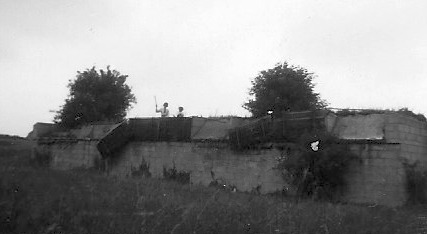
The block structure that we called ‘The Fort’ was actually a series of three hoppers with wooden gates (which had mostly gone) for loading lorries with sand. Lots of fun was to be had there!
The last landmark on our circular tour would be ‘Pilot Hill’, a grass covered mound, not unlike Ayers Rock in Australia in shape, but only about twenty feet high. I have absolutely no idea how or why it got its name ‘Pilot Hill’, but it was always known as that. This path now brings us back to the stile that leads into my Mum and Dad’s rear garden.
I was so lucky to have this ‘playground’ as a kid, where I would disappear for hours, coming home when I was hungry after all sorts of mini-adventures and heroic battles won! Nobody worried much about ‘Health & Safety’ then. We got over our injuries, and learnt to be more careful next time.
As I grew up and no longer played in the Pit, Mr. Lacey-West died and the land was sold to developers. Noel and Nigel’s big bungalow was demolished to provide space for the access road (this bungalow actually belonged to their Grandmother, Mrs. Cullen).
They built about thirty-six bungalows on this site and called it “Galley Fields”, but it was still affectionately called “The Pit” by locals. (All creative rights reserved to Graham.)