Abingdon Poetry Groups


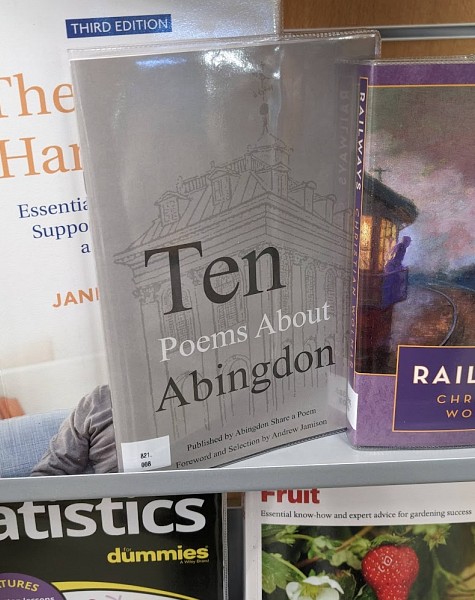
You may remember I published a book called ‘Ten Poems about Abingdon’ last year. There are copies in Abingdon Library, and still, a few are left for sale at The Book Store and Abingdon Museum. The books sell at £5, and the profits, about £4.25 a copy, go to The Abingdon Bridge young people’s charity. (The book was dedicated to Pauline Sykes, who leads the Abingdon Share a Poem group.)

There are other poetry groups in Abingdon and some excellent poets. I know of the U3A poetry group and the Quaker poetry group.
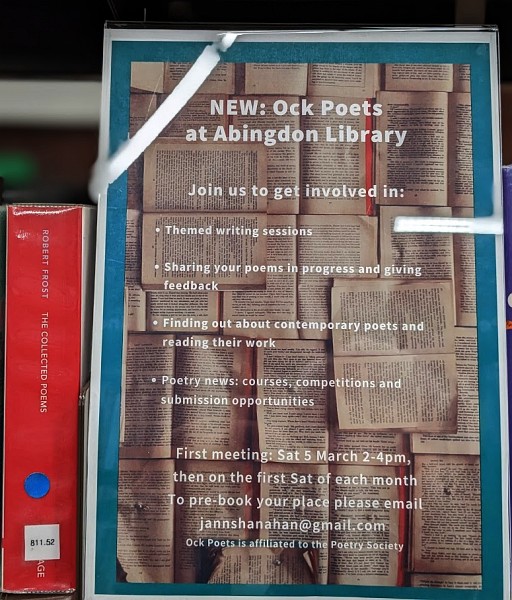
There are also the Ock Poets who meet in Abingdon Library and are eleven months old. They began in March 2022. They are a group who write poetry, have a monthly talk and a themed exercise and share their poems. The next one is tomorrow, but it is best to email the address on the poster first.

Here is an example of a poem by an Abingdon Poet called The Sea by Justin Gosling. Justin passed away last November, and I hope his family won’t mind me sharing this reading. (All Rights Reserved.) He read it in the Abingdon Share a Poem group. It can be found in his poetry book The Jackdaw in the Jacaranda, which can probably be ordered from local bookshops and is definitely available online.
Leach and sons at Trinity Church


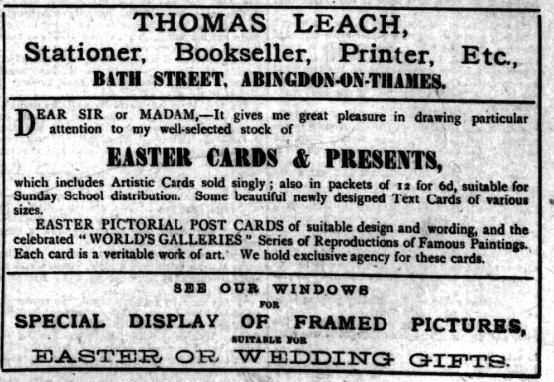
Thomas Leach moved to Abingdon with his young family and opened a shop in Bath Street in 1900. He was a printer and sold books and stationery.

The Leach family went to Trinity Church and had a big influence. Thomas was a lay preacher and preached at Trinity and many free churches in Abingdon and surrounding villages. He also worked for the temperance cause and preached a famous sermon on temperance at Trinity in November 1909, where he calculated if the £22,500 spent on drink in Abingdon in 1908 were saved for three years, two hundred families could be taken from the unsanitary courts of Ock Street and moved rent free to good houses.

Norman, the youngest of his sons, died at sea in 1918, a wireless operator on the S.S. Arka, sunk by a German Submarine. William was badly injured in the trenches and died fairly young.

Two other brothers were well known in Abingdon and at Trinity Church. Frederick managed the printing works, while Victor managed the Bath Street shop. The printing expanded and moved from the back of the Bath Street shop to Ock Street in 1937.

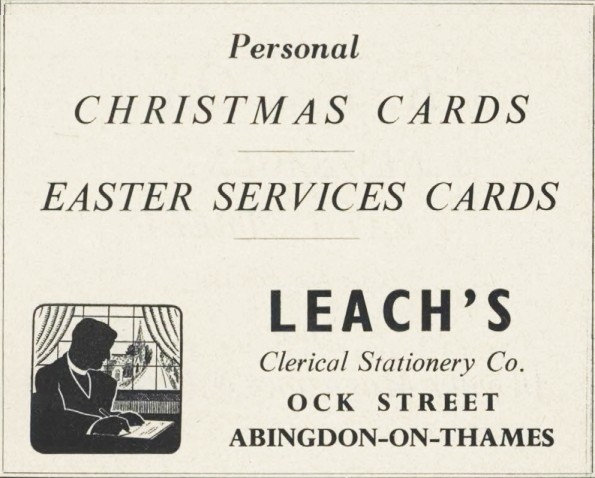
The firm was well known for its clerical printing and had a dog-collared cleric as a logo for its clerical business. Leach’s offering envelopes were well known among all denominations, and how many church people heard of the town Abingdon-on-Thames.

Frederick was remembered at Trinity as being kind and generous. He produced and distributed Trinity News free of charge. He gave generously to surrounding churches and to the elderly and sick children.

Victor was a choirmaster at Trinity and a founding member of the Abingdon Music Society. In 1959 he laid the foundation stone of All Saints Methodist Church. He was also involved in the renovation and modernisation of Trinity Church, moving the organ and later reordering the church, replacing pews with seats.

References:
1. History of Trinity (Wesleyan) Methodist Church by D.B.Tranter.
2) Information by Jonathon Leach at https://www.abingdonfirstworldwar.uk/leach.
3) A Oxford Mail article when the Leach printing business moved from Ock Street https://www.oxfordmail.co.uk/news/2091421.new-chapter-print-firm-illustrious-past/.

Thank you to St Helens and St Katherine’s for the ecclesiastical publisher’s advert. The other advert came from The Abingdon Free Press on the British Newspaper Archive in 1906.

Old Abbey House – new roof


There has been a lot of activity at Old Abbey House, with tradespeople coming and going. The roof looks nearly complete, but it is difficult to tell how work is progressing inside and when the hotel will be open.

P.S. The planning application for widening the gate was the hotel at Cosenors House. I saw ‘hotel’ and did not double-check. Apologies

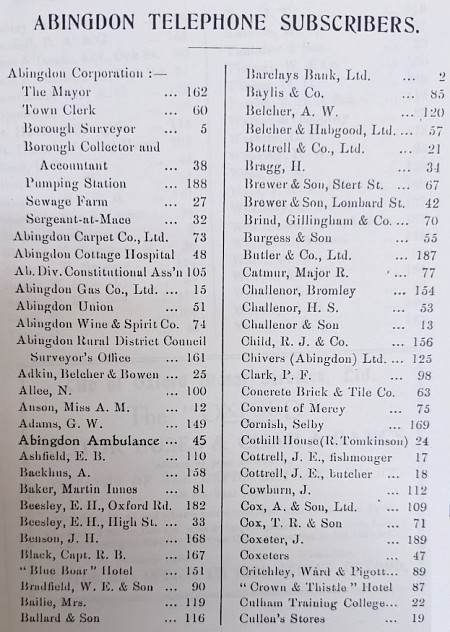
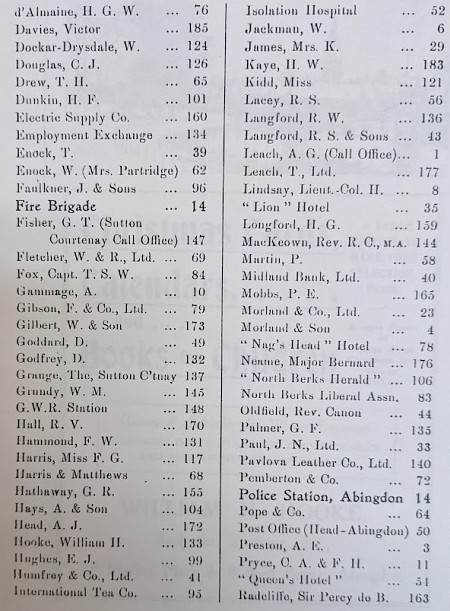
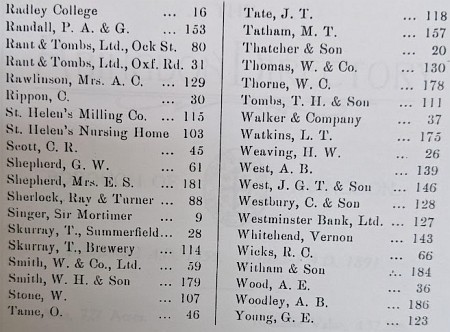
Abingdon Telephone Subscribers in 1928


This telephone directory would have been around 1928 when the telephone exchange was in East St Helen Street.

  1. A. G Leach
  2. Barclays Bank Limited
  3. Alderman A.E Preston
  4. Morland & Son
  5. Abingdon Borough Surveyor

Somebody phoning from outside Abingdon would have their number connected by using the place and number such as ‘Abingdon 2’. This allowed calls to be placed initially through the local switchboard operator to the number and later by local or national dialling codes.

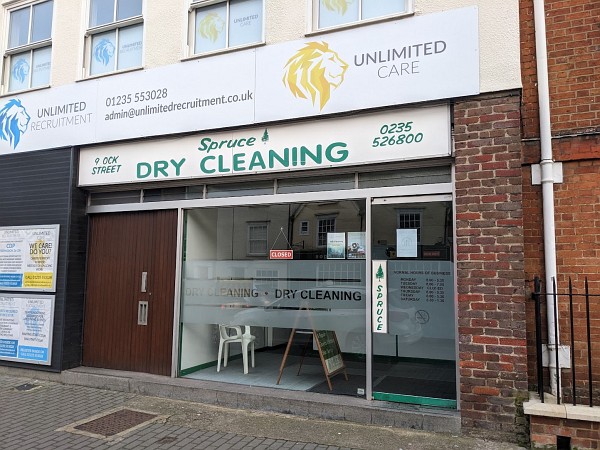
Some signs still show the original Abingdon national dialling code of 0235, which became 01235 on 16th April 1995 – known as PhONEday.

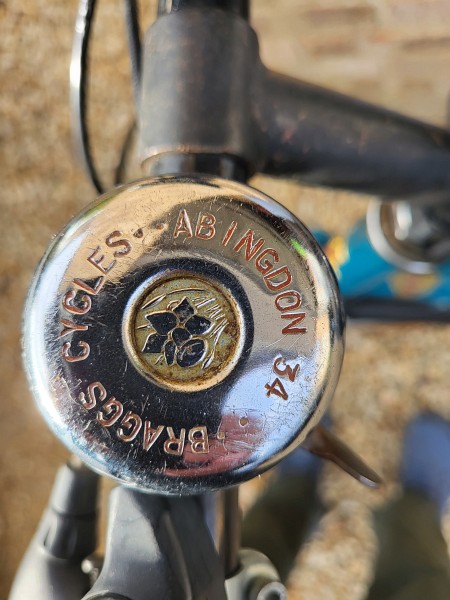
P.S. Thank you to Glenn for a picture of his bike bell from Braggs with the number Abingdon 34.