Radley Ash Disposal Lake


This sign is to be found near the Sustrans Cycle path beyond Abingdon Science Park . This, the largest of the lakes, was pumped dry two winters back. The fence was erected, and then instead of water, it was pumped full of fuel ash slurry from Didcot Power Station.
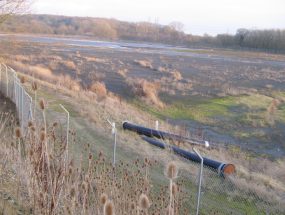
Growing on the slope in the foreground is teasel. Down beneath stretches a black morass, partly covered by reeds and grass: nature reclaiming the level ground. Gulls float on an area of water in the distance.

This was never the most beautiful of the gravel pits. Its sandy coloured bottom hosted few plants. The perimeter path, built up on dug-out mud, was and is the play area of cross-country trials bikes. Their phutting and snarling annoys dog walkers out for a peaceful walk.

But where the Sustrans cycle path nears Radley, there are lakes that have had forty+ years to mature. They are the subject of the campaign to Save Radley Lakes. We thought the plans to fill them with ash had been defeated but now nPower have new plans to just fill one of them (the largest) and posters around the area say the danger still remains, and we should continue fighting to save our neighbourhood.

Crooked Roads


This plaque on Lombard Street says “This Street widened at the cost of the Corporation 1874. John Kent Mayor.”


Before planning regulations, buildings could be jammed together in a higgledy piggledy way. The result would be some narrow crooked roads.

Abingdon Corporation in the 19th Century started to buy up dwellings or parts of dwellings to straighten out the kinks and narrow stretches of the main thoroughfares. This passageway from Queen Street to the Market Place gives an idea of the challenge they faced.

This building gives Stert Street its distinctive character, but does risk getting knocked by a passing lorry or bus.

Bells Appeal


St Helen’s bells have rung their last peal, and this morning the church was open to give passers by a first and last look at the old bells before they are taken away. Six are going to a Cathedral in South Africa and the others will be recast.

The English style of bell ringing involves the bells swinging through a full 360 degrees from mouth up to mouth up and back. The continentental style is for a hammer to strike the bell. The English style gives a richer sound but is more wearing on the frame, and the bell ringers.

These bells were first hung in 1764. The frames no longer hold the bells securely, and the frame is wobbly, and the bells heavier than is necessary, and so it it was decided to APPEAL for a new set.

The new bells have been cast in the Whitechapel Bell Foundry. and are waiting at Whites of Appleton (The Bellhangers), They will be hung in the spring.

Poem inspired by Abingdon’s Guildhall


I’ll tell you of the Guildhall
Its rooms for public use –
The ancient and the modern
all fused without excuse.

One end is made of concrete,
A nineteen sixties crime
It doesn’t fit the setting
Or the medieval time.

It used for organ concerts
for craft fairs and a ball.
It has a stage and balcony
and is called the Abbey Hall

Walk across the foyer
And through an ancient door
You’ll find the council chamber
Wood panelled long before.

It boasts some lovely paintings
A Gainsborough King and Queen
Next door you’ll find the bear room
Where the Bear Club can be seen.

And down below more history
A room of ancient fame
The first schoolroom in Abingdon
The Roysse Room is its name.