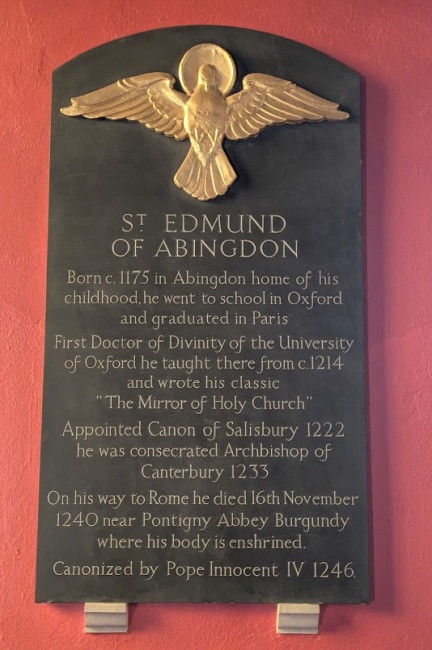
Edmund Rich – later to become St Edmund of Abingdon – was born in Abingdon around 1175. St Edmund’s Lane in Abingdon preserves the memory of what was traditionally regarded as his birthplace, and there was once a chapel dedicated to him in that area. St Edmund’s Catholic Primary School in Abingdon and Our Lady and St Edmund of Abingdon Church are also dedicated to him. There is a plaque in his honour in that church (above) and another outside St Nicolas Church where his mother was buried.
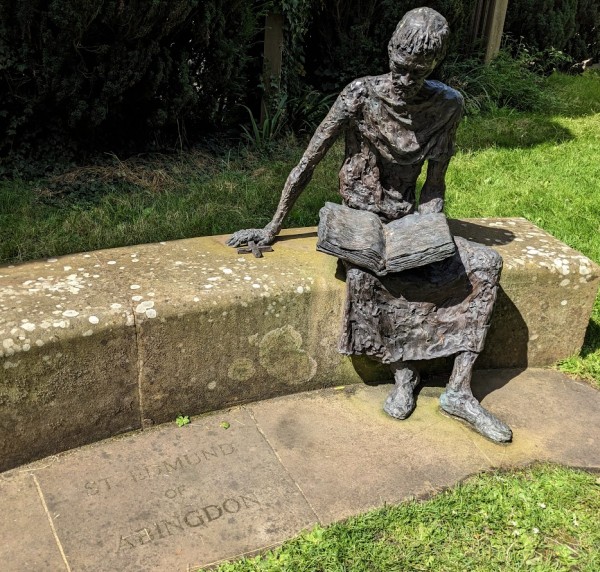
Beyond Abingdon his fame was to grow. St Edmund Hall, a college of the University of Oxford, is also dedicated to his memory as a teacher and has a modern statue there in his memory. He studied in Oxford and Paris and taught in Oxford. In 1222 he became Canon of Salisbury Cathedral during the cathedral’s great building period. In 1233 Edmund became Archbishop of Canterbury. He was known for personal austerity, care for the poor, and for defending church rights during the reign of Henry III. His efforts to challenge royal interference brought him into conflict with the king. He left England intending to present his case to the papal court in Rome, but he fell ill on the journey and died in France in 1240. Edmund was buried at Pontigny Abbey, where he became venerated as Saint Edme. He was made a saint in 1246, only six years after his death.
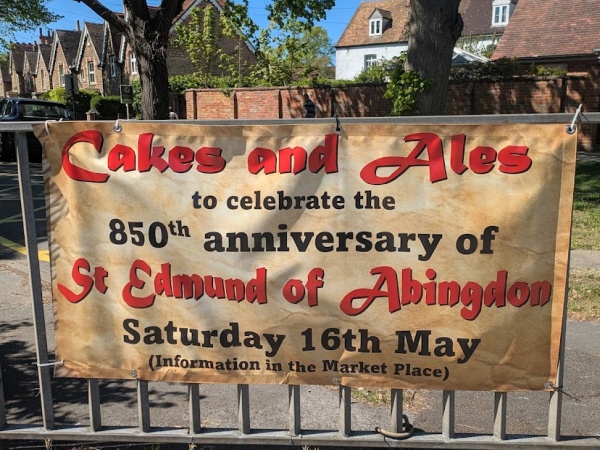
Abingdon is marking the 850th anniversary of St Edmund with the ‘Cakes and Ales Festival’ on Saturday 16 May 2026. The celebration includes music, refreshments and community events connected with St Edmund’s life and legacy. There will be a Medieval Recipe Cake, a talk on Anglo Saxon Beer-Making, a cake stall on the Market Place and a Loose Cannon Special 850th Ale.
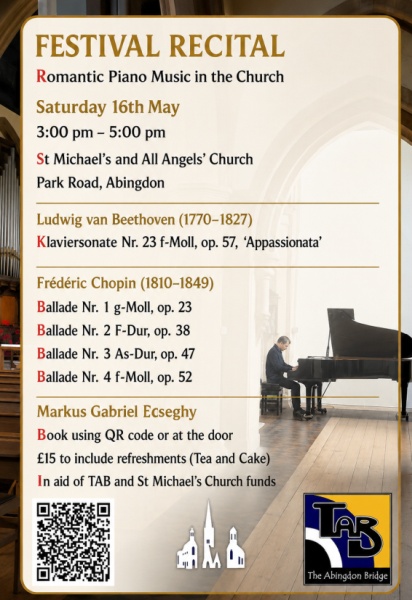
One featured event is a piano recital at St Michael and All Angels Church at 3pm, followed by tea and cakes.

Another event is a Ceilidh at St Michael’s.
A fuller weekend of events can be seen on the official leaflet. Most of the other events are free.
I went with my family to a (Friends of Abingdon?) lecture about him when i was little. I seem to remember he had his vision at the top end of Victoria Road, and that someone once tried to kill him with poison (he was apparently not a pleasant man). There he was, fevered at death’s door, when he suddenly decided not to die, and overcame the effects of the poison with sheer force of will.
Why are we celebrating St. Edmund this year instead of last year, as 850 years ago was 1176 (Yes l do realise his date of birth is c1175). Or am l missing something?