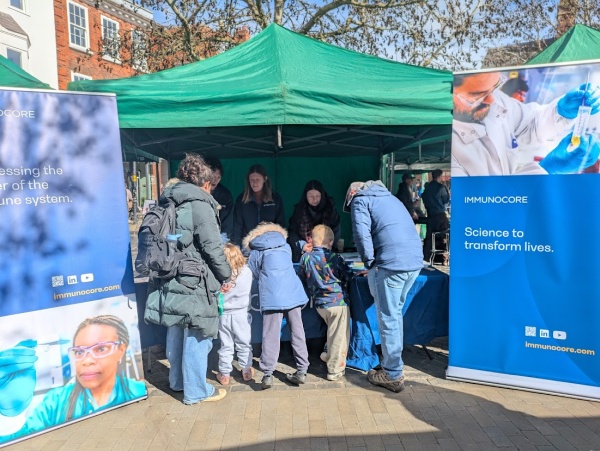
The ATOM Science Festival was on the Market Place and under County Hall today with more than twenty stalls, many of them from local science organisations such as Immunocore from Milton Park.
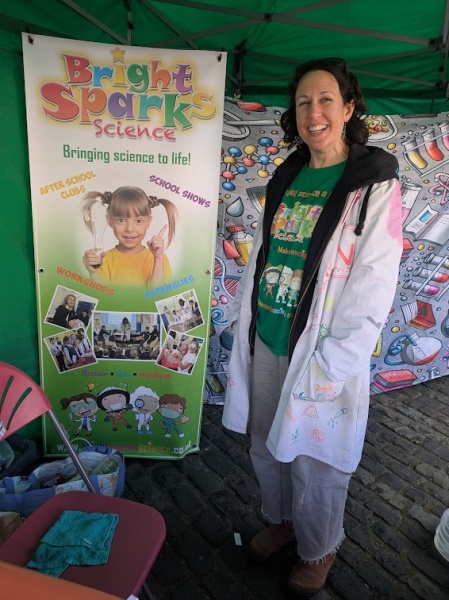
Bright Sparks Science are based on Northcourt Road in Abingdon and run hands-on science activities for schools and special events.
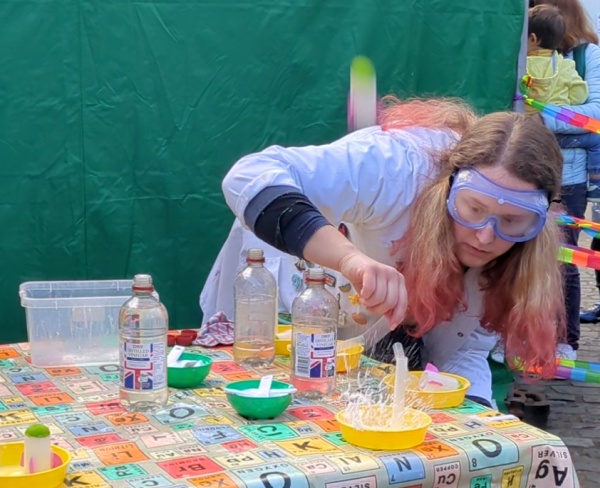
Children were mixing vinegar and bicarbonate of soda (common kitchen chemicals) to launch rockets. After standing back, they watched as the rockets were propelled into the air.
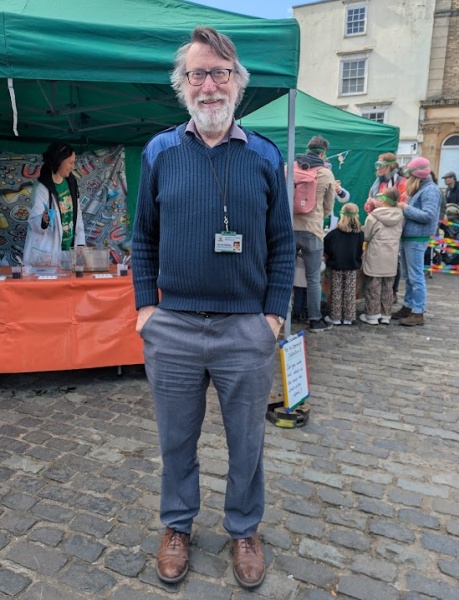
Dr Jim Halliday was looking around and chatting with stall holders. He is the leader of Abingdon-on-Thames Town Council and also works for the Science and Technology Facilities Council at Harwell Campus.

The Owl Conservation Project had information about their work looking after owls and had a Tawny Owl with them. Tawny owls have declined in the UK in recent decades, but they are still the most common owl species in Britain.
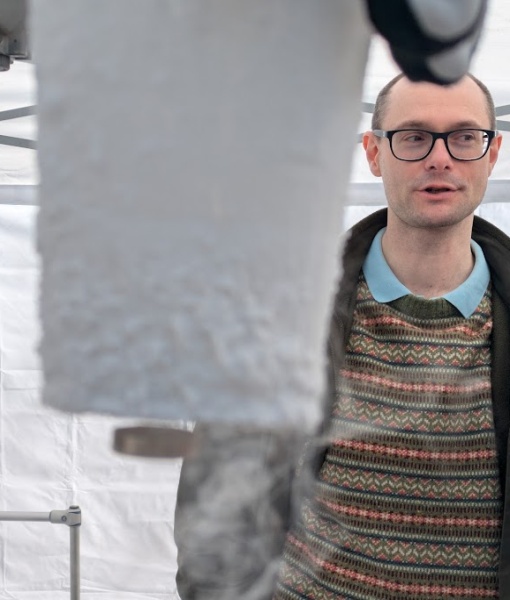
At the Oxford Materials stall there were demonstrations of Type II superconductivity. A superconductor is a material that, when cooled below a certain temperature, looses all electrical resistance and strongly affects magnetic fields. A superconducting disc is cooled using liquid nitrogen, and when a magnet is placed nearby the magnetic field becomes locked in place by the superconductor. This makes the magnet float in a fixed position.
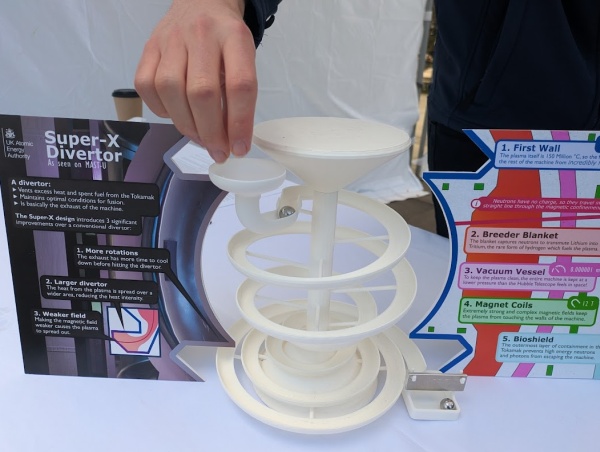
The UK Atomic Energy Authority had a stall showing how scientists are trying to generate energy from nuclear fusion. Visitors could try computer games where they attempted to start and control fusion reactions, learning how difficult it is to keep the plasma stable.
There was also a marble track to demonstrate how a divertor works. In a fusion reactor the plasma becomes extremely hot, and some particles must be safely removed to prevent damage to the reactor walls. The divertor controls the exit of the heated particles leaving the plasma.
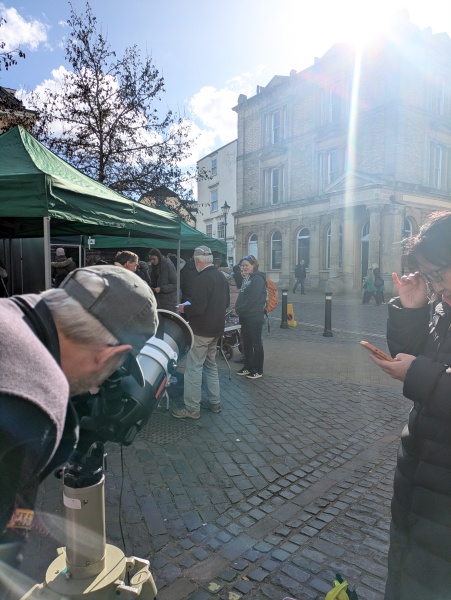
The Abingdon Astronomical Society had two telescopes pointed at the Sun. Through one could be seen sun spots. Through the other solar flares.
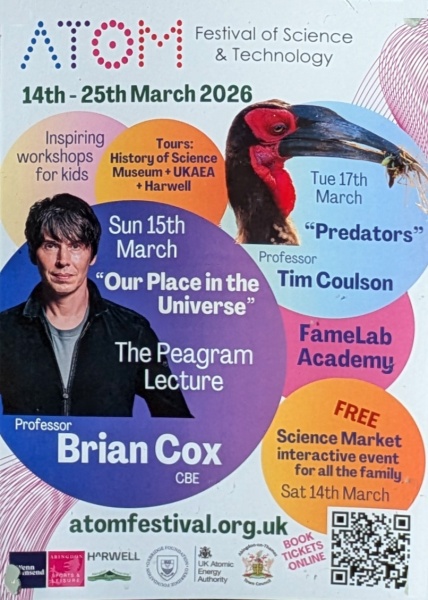
It was interesting to learn about all this and more. The ATOM Festival continues with talks and tours, which can be found on their website https://www.atomfestival.org.uk/festival-programme/. This year’s Peagram Lecture will be given by Professor Brian Cox. I looked for a ticket about a month ago but found they were already sold out. I am told by the organisers there is no point going along in the hope of a ticket, but there are still tickets available for other talks and tours.
Coming back to the discussion about the town what’s on page – I came upon this event by accident and had not seen any advertising for it. It was good to see this event and take part but I have to ask – where was this advertised and how do we do better with raising awareness for the events happening in and around Abingdon. Surely we should be asking if the town what’s on page is a) fit for purpose and b) sufficient effort is put into marketing it as a go to destination for events info and listings
While I agree there needs to be some joined up thinking about advertising events, this particular one did seem well advertised – as well as all across social media, there were also loads of posters up and large advertising banners tied to railings.