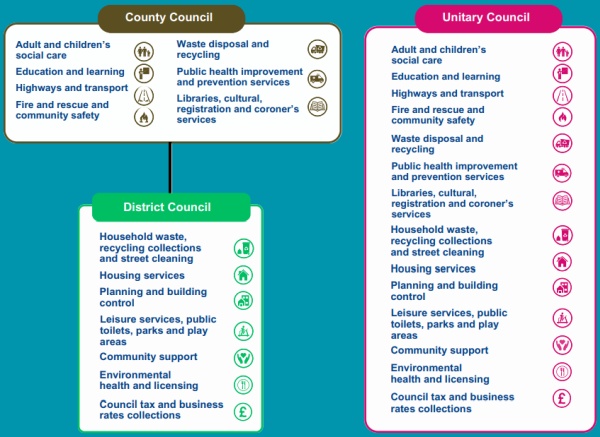
At the moment, Abingdon is within Vale of White Horse District Council and Oxfordshire County Council. That means different services are currently provided by two levels of local government.
The national government is asking people for their views on three different options to reorganise local government in Oxfordshire. All three would replace the current system of county and district councils with new unitary councils – single authorities responsible for all the principle services.
Town and parish councils, including Abingdon Town Council, would continue as they are with minor changes.
The diagram above shows how responsibilities would move from the current two-level system to unitary councils. The consultation on the three options runs until 26 March 2026.
Two of the three proposals include West Berkshire, even though it is not in Oxfordshire. This is because the government expects new unitary councils to serve around 500,000 people or more, and South Oxfordshire and the Vale together do not add up to that much.
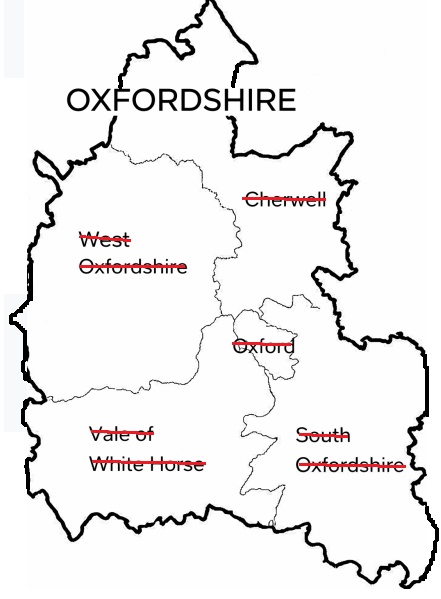
Option 1 — One unitary council for all Oxfordshire – based on the current Oxfordshire County Council boundaries – proposed by Oxfordshire County Council.
This would replace all the district councils with a single council covering the whole of Oxfordshire. The single council would serve around 780,000 people.
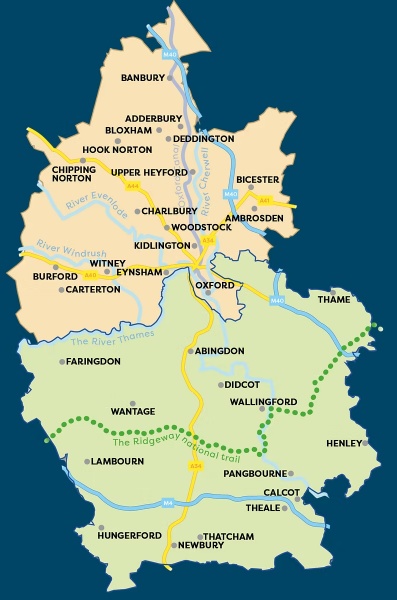
Option 2 — Two unitary councils – Proposed by the four district councils and West Berkshire unitary council – combines existing district and city councils
This would create two new authorities:
- Oxford and Shires Council (Cherwell, Oxford City, West Oxfordshire)
- Ridgeway Council (South Oxfordshire, Vale of White Horse, and West Berkshire)
Each would have just under the 500,000 population the government is looking for.
This would be smaller and presumably more local than Option 1. It would also renew Abingdon’s ancient Berkshire link. The northern part of Berkshire was moved into Oxfordshire in 1974, with Faringdon, Wantage and Abingdon and their villages becoming the Vale of White Horse district. Didcot and Wallingford were added to South Oxfordshire (1).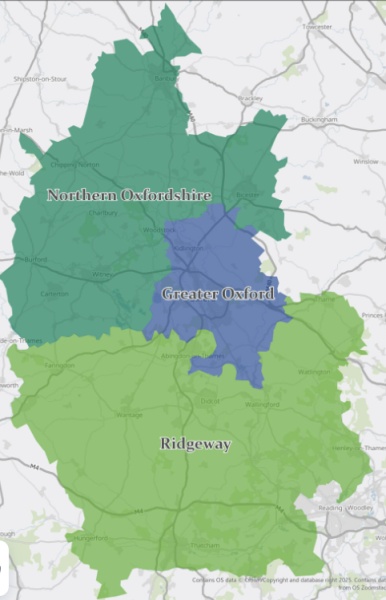
Option 3 — Three unitary councils – is about creating a Greater Oxford as proposed by Oxford City Council
It would create:
- Greater Oxford Council (Oxford City plus surrounding land)
- Northern Oxfordshire Council (Most of Cherwell and West Oxfordshire)
- Ridgeway Council (South Oxfordshire, most of the Vale of White Horse, and West Berkshire)
These councils would be smaller than the government’s 500,000 population guideline, which could make this option less viable.
There are a lot of documents to read and you can respond to the consultation at https://www.gov.uk/government/consultations/local-government-reorganisation-in-oxfordshire/proposals-for-local-government-reorganisation-in-oxfordshire
Unfortunately there will be no referendum. The final decision will be taken by central government.
I think this is an overdue change and all three of the options are better than the current system. I filled in the consultation surveys run by each of the options but it was odd that 2 of them didn’t actually ask which option the respondent preferred. It certainly felt like they were looking for stats to support their preference rather that understanding the community’s preference.
Just sad to lose the name “Vale of the White Horse” and the horse symbol, it’s an old connection, and a link to when Abingdon was in Berkshire.
Two councils are better than one, or three, in my opinion.
The name “Greater Oxford” is a bit grim, becoming one homogenous blob like London.
As long as a fortune is not spent on rebranding this, because so often that can be a money pit, with councils getting ripped off by preferred suppliers/contractors, and money being taken out of our cash-strapped services while our cars crumble into the multiplying potholes.
Anything is better than the current system whereby we have 3 councils doing different things in the same area and no-one is sure who does what. Whichever option is chosen, at least we’ll only have 2 after the reorganisation. Hopefully the Town Council will have more say in local issues such as the provision of road safety features, currently the responsibility of OCC which has no particular interest in Abingdon.
I was interested to learn about Oxford City Council’s plans for a “Greater Oxford”, In their overview they said “Currently, almost all of Oxford’s Green Belt – which was created in 1975 – sits outside the city’s administrative boundaries. And, because Oxford has built up to its boundaries and has largely run out of space, new homes for the city are often built in towns and villages across Oxfordshire. By moving the Green Belt within the Greater Oxford boundaries, high-density homes could be built near to existing jobs, transport networks and communities.” By following many links (and blind alleys) I eventually managed to find a map of what might be “included” within Greater Oxford – the map is at https://www.oxford.gov.uk/downloads/file/3844/three-unitary-authorities-proposal—appendices (see Fig A.3 and Fig A.4) and then take note of the words say “In line with Government guidance, parish councils have been used as the building blocks for these changes. Where parishes straddle the boundary, an in-out decision has been made largely on the basis of settlement patterns. Parishes that sit in the natural expansion space for Abingdon (Ridgeway) have been included in the Ridgeway geography.”
Translating this into Plain English – and looking at the map – the parishes of Wootton, Sunningwell, Kennington, Nuneham Courtney, Culham are all within Greater Oxford , as is most of Radley Parish. The only areas within the Ridgeway Area that are with Abingdon are Shippon, plus an undefined bit of Radley, and all of Drayton.
If you have read this far then I invite you reach our own conclusions – my personal view is that the option that includes a “Greater Oxford” is not good news for Abingdon, but also that it would good if lots of people reply to this consultation.
That would need lots of people to know about the consultation in the first place. In my experience, none of local councils are good at publicising consultations ‘far and wide’, i.e. in a way which means that lots of ordinary members of the public are lilkely to know about them and become actively interested in them.
I had no idea this was underway until I decided to take a look here (as I do once in a while). I’ve just googled to find out more, and the OCC website is completely blocked for some reason; there’s nothing on Abingdon TC’s website about it; and the Vale has an article ‘Residents urged to respond to government consultation on once-in-a-generation opportunity to change local councils’ dated 5 February tucked away on its website, where very few people are likely to find it. And so it goes on.
I agree that a move to a single tier above the Town Council is to be welcomed, but It is very difficult to know how any of these would pan out, not least because as well as the structural issues, there is the question of the capability- and vision – of those who will be implementing the chosen solution. If it all becomes mired in party-based shenanigans among the elected representatives and jobs-worth attitudes among the officers, we are will, to quote Corporal Jones, be “doomed”.
Thinking about what we have seen since the South and Vale merger (even though that was only “back office”, not political), I would suggest that the plus was probably economies of scale at the higher levels, professional, strategic etc, but that was offset by massive reduction in local knowledge among officers at all levels. The latter was compounded by the growth of working from home – I have come across officers in planning or property-related roles who live 60+ miles away and have never been to Abingdon.
It is also noticeable that all the S&V market towns seem to feel hard done by in relation to each other.
So whichever system is chosen, it is vital that it incorporates mechanisms for local people to access council services, for officers to develop local knowledge and for local councillors speak up for their “patch”.