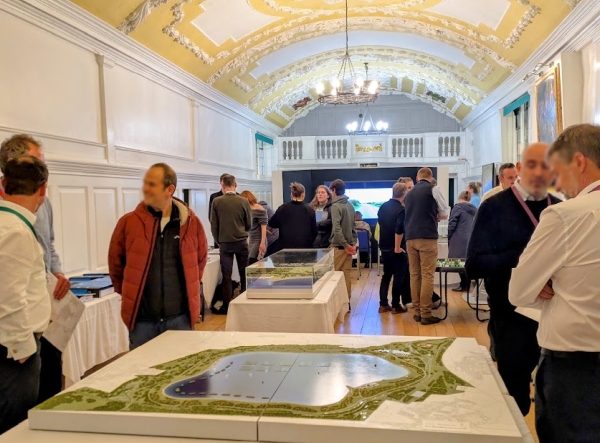
The South East Strategic Reservoir Option (SESRO) – now renamed the White Horse Reservoir rather than the Abingdon Reservoir – is currently the subject of a Statutory Consultation. Yesterday there was a display in the Guildhall in Abingdon given by Thames Water, working with Affinity Water.
The Roysse Room, featured models of the reservoir and embankments, and a 3D ‘drive-round’ video.
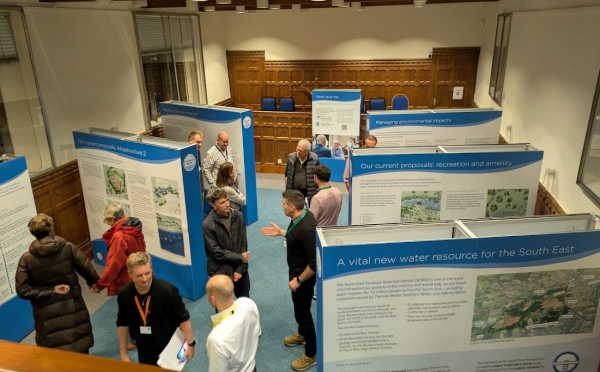
Information boards were set up in the Magistrates Court.
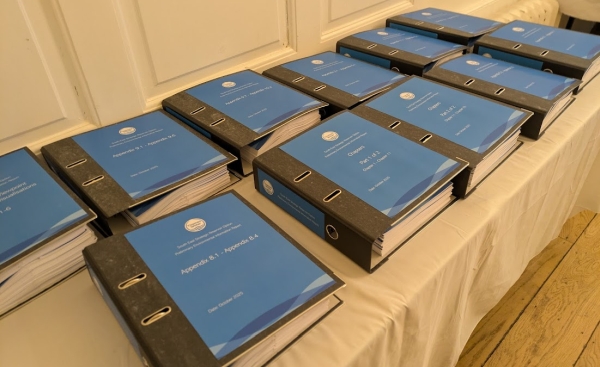
There were more design documents and appendices for those who need more details.
The large reservoir proposed near Abingdon has been progressing through the national RAPID “Gate” process, which reviews major water-resource schemes at 5 gateway stages to ensure the scheme is viable and affordable and wanted at each gateway before progressing.
At Gate 1 in 2021, the project was confirmed as technically feasible as a concept.
By Gate 2 in 2022, Thames Water had fixed the preferred size at 150 million m³ and estimated the delivery cost to about £2.2 billion (Ofwat SESRO Case Study).
Now at Gate 3 (2024–25), after detailed site and engineering work, the projected cost has risen sharply. The consultation documents suggest a range of £5.5–£7.5 billion. (It will be paid for by customers of the water companies over about 100 years.)
This led Vale of White Horse District Council in October 2024 to warn of ‘spiralling costs’ and call for a rethink, questioning whether such an expensive scheme is the best long-term solution for the region’s water supply (VWHDC statement).
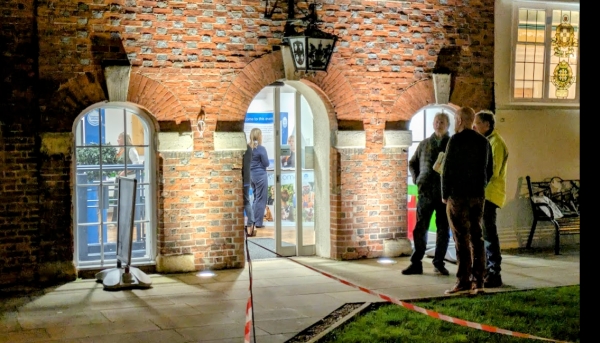
Inside the Guildhall, the case was being put for the reservoir. Outside, a representative of GARD (Group Against Reservoir Development) handed out summaries of the case against.
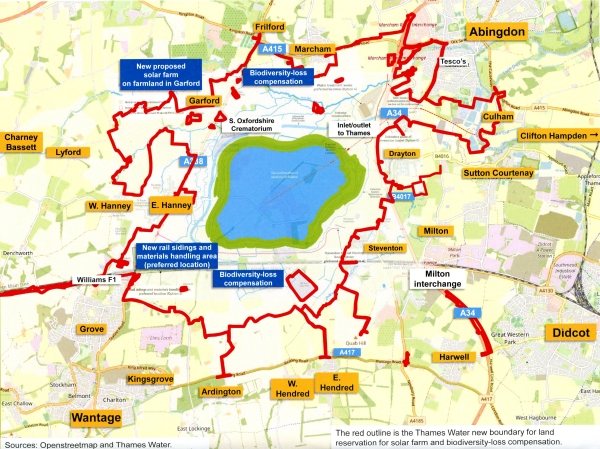
New GARD objections, alongside long-standing environmental and community concerns, involve the escalation in cost and the expanding size of the scheme. The reservoir area now requires 38 km² of land – not only for the reservoir itself but also to restore lost biodiversity, relocate solar farms (some will float on the reservoir), mitigate flood risks, and reroute watercourses.
The consultation materials are available online at SESRO statutory consultation 2025. The consultation runs to 13th January 2026.
Gard material can be found at groupagainstreservoirdevelopment.org.
I thought the plans and diagrams were interesting, plus the chance to speak with the experts. One board had the surprising information for me that there will be a pipeline to Farmoor so there could be some local benefit. Those wanting to rebuild the Wilts and Berks canal will like the planned water channel around the northern perimeter of the reservoir that could be turned into a segment of the canal. But locks will need to be added.
Once con-pleted they’ll probably sell the reservoir to Amazon (or similar) to cool-down a suite of data-centres …
Why would the planners be taking a busted flush like TW seriously on a questionable scheme like this?
And that row of blue files … ‘Hey, look teacher, we’ve done our homework’ …
I despair.
I live in an area that isn’t a flood zone. The reservoir will push up ground water level so I – and a lot of areas – will now be in a flood zone. This will affect my insurance. Did they mention this specifically; what was their answer?
The “walls” of the reservoir will be the highest “building” around – some 20m +; that is as high as two even three houses. That is actually really high thing in this diary land area. is this mentioned, specifically?
These 20m high walls, in engineering terms, aren’t able to hold the water in place, tests show it will fail. Was this mentioned, specifically?
The public “use” of the reservoir is either nil or limited. Is this mentioned, specifically?
The “artistic impressions” we see regularly of the nirvana esq public space of the reservoir are at best misleading and at worst entirely false. Is this mentioned, specifically?
How will this reservoir be filled? If it is “from rivers”; how will they fill it if the rivers are full of poo? Is this mentioned, specifically?
Will the reservoir be used as an asset to pay shareholder dividends but paid for by rate payers, as opposed to be being paid for by those profits/dividends FIRST? Is this mentioned, specifically?
We need this reservoir to provide water to London, but a Farmoor reservoir amount of water is lost to leaks every 5 days. So, fixing the leaks means we could, in effect, have a “new Farmoor reservoir built every 5 days” instead, for less cost. Is this mentioned, specifically?
No one has ever built a reservoir of this size before. Are we seriously thinking that TW are the people we trust to deliver such a thing? Is this mentioned, specifically?
How do the costs of a reservoir (that isn’t safe), that will be so high and deep it will affect ground water levels everywhere, that can’t be filled because of the sewage in the rivers, that is paid for by bill payers rather than shareholders….how does all these costs compare to the alternatives?
Remember….we have hosepipe bans because the reservoirs are empty. The reservoirs get topped up by the rivets. But the rivers can’t be used to top up the reservoirs, not because there isn’t enough water, but because the water we have can’t be used to fill the reservoirs we already have – because of the poo.
Anyway…that’s what the lady down the pub told me 😏
Daniel – did you attend the event or raise any of these burning questions you have directly with Thames water – specifically?
We have now been visited by two men asking if we intend on completing the paperwork we have been sent ‘as it really is very important’.