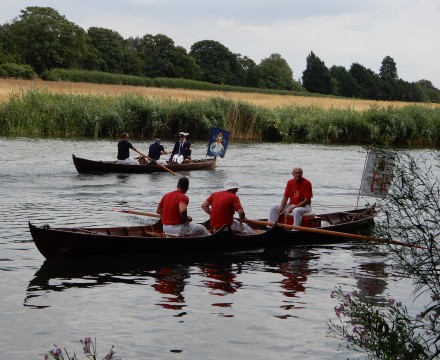
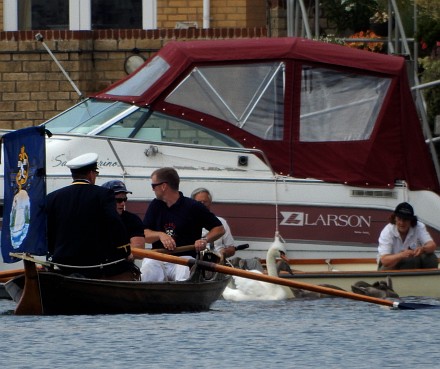
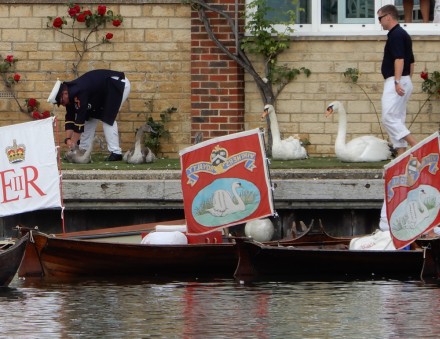
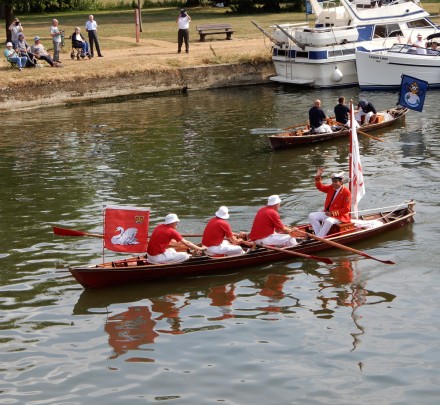
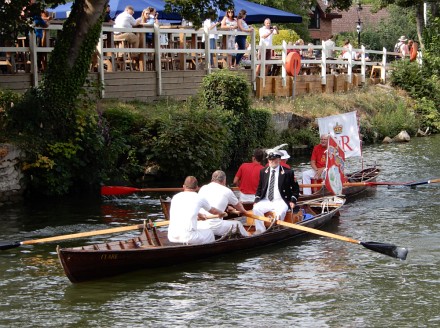
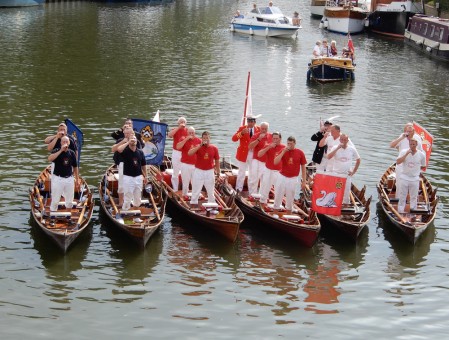
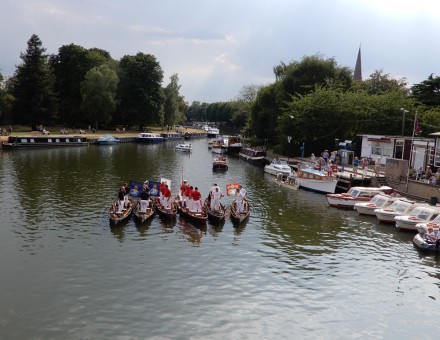
Thanks to Steve for sending a text so say the Swan Uppers were leaving Culham Lock. At Abingdon marina some local boat owners told the Swan Uppers there were two swans and seven cygnets nearby.

The Swan Uppers followed their directions, and drew a circle of boats closer and closer round the swans.

They then moved the swans to the nearest garden to ring them, weigh them and give them a health check.

A little later the Swan Uppers arrived at Abingdon Bridge. They did not stop there, but rowed through the bridge in the direction of Abingdon Lock. The crowd, who had been waiting one side of the bridge, moved to the other side to watch them go.

The swan upper returned a few minutes later after this unexpected diversion.

They then brought the boats together and shared out the last of their rum, and raised a glass to ‘The Queen.’

Swan upping is an annual ceremony in England in which mute swans on the River Thames are rounded up, caught, ringed, and then released. It normally finishes at Abingdon Bridge.
Category Archives: wildlife
A natural grass diet

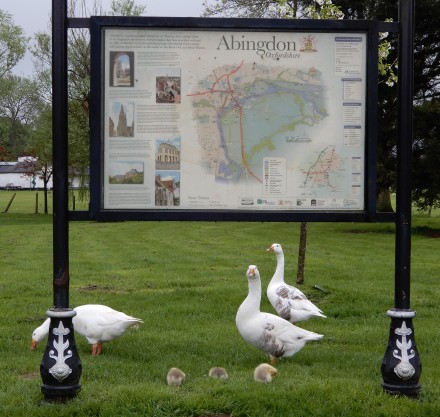
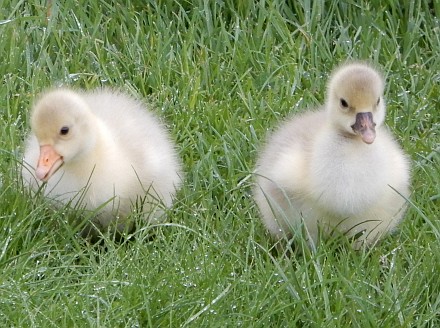
This group of goslings, with some older geese, were under the Abingdon Map beside the River Thames this evening.

The goslings looked very young but were already able to walk, and swim, and eat grass.
They will be much better off if they are just allowed to eat grass – NOT given bread which is to them a junk food. We humans can get away with eating junk food now and again, but baby birds grow up much quicker and so for them a natural grass diet will make them strong and healthy. Bread won’t.
Science and Conservation on the River

Mark Bradfield of BBOWT (Berks, Bucks & Oxon Wildlife Trust) led a walk this morning as part of the Atom Science and Technology Festival. Passing through the lock he showed us a leaflet with paw prints so that we may now be able to tell a badger from a dog, and a mink from an otter. Mark was also interested to find that two of the earliest Lock keepers on the heritage board were Bradfields – possibly his ancestors.
He told us a lot of things on the way including what BBOWT is doing to control invasive animals like mink that are a real danger to Water Voles.

At the weir near swift ditch he identified someĀ otter spraint (droppings), probably left as a territory marker. Otters are starting to make a comeback, and often eat theĀ American Signal Crayfish (an invasive creature).

Mark also told us how important backwaters are for protecting fish from getting swept away. Backwaters and reed beds also help prevent flooding as not all the water goes down one fast channel.

He praised the reed beds over the other side of the river where a heron was stalking fish.
There was light snow falling throughout the day, and it was chilly. So after the ninety minute walk it was good to get back in the warmth. I visited the Community Shop (Free Space) where lots of children were enjoying making crystals as part of the Science Festival. The Market Place activities were not possible today because of the wind, but there are still lots of indoor talks and activities for the next week. See http://www.atomfestival.org.uk/
Please correct anything I got wrong in quoting Mark.
Osprey Sighting
Thanks to Steve for this from 1st September

Excuse the poor photos but we couldn’t contain our excitement yesterday when around 2.00pm this Osprey began fishing almost opposite us in Wilsham Road on the River Thames in Abingdon.