Category Archives: museum

New Fossil Display in Abingdon Museum Attic


The Attic Gallery at Abingdon County Hall Museum has a new addition. Alongside the museum’s usual array of large fossilised creatures, fossil collector Dr James Etienne has unveiled his collection of locally discovered fossils for the first time.

One notable exhibit is  ‘Abby’ the Pliosaur, found near Abingdon in autumn 2023. Only the skull — complete with teeth — is currently on show, but it represents one of the most complete Pliosaurus reptiles ever uncovered from the Late Jurassic period. Excavated from local Kimmeridge Clay, ‘Abby’ lived around 150 million years ago and was a dominant marine predator.

Putting her back together is not easy. Her lower jaw came out in over 70 pieces. The body of the skeleton is being prepared and will be the subject of research by the University of Portsmouth and the University of Bristol.

Dr Etienne’s collection is on display in the Attic Gallery from 17th May to 7th September 2025 and fills several cases. There are also display boards to show what the creatures may have looked like.

The museum is run by Abingdon-on-Thames Town Council.

“Atomics to Medieval Knights” Explores the Rich History of Fitzharris Manor Estate


Abingdon Museum has created a fascinating new exhibition, “Atomics to Medieval Knights – a History of Fitzharris Manor Estate,” which opened on Saturday, 11th January. This exhibition explores the history of Fitzharris Manor, tracing its evolution from its origins shortly after the Norman Conquest to its transformation into the Fitzharry’s Manor Estate.

Visitors can journey through time, from display board to display board, and through artifacts, exploring how the Manor changed hands and underwent architectural changes across centuries. The exhibition then shifts its focus to the mid-20th century, when the arrival of the Atomic Energy Research Establishment (AERE) at Harwell changed Abingdon.

With the influx of scientists and engineers – nicknamed the “Atomics” – a new housing estate was built on the Fitzharris Manor site. The exhibition highlights the  planning and construction of this estate, and the cosmopolitan community that moved in. By 1959, Harwell staff and their families made up nearly a quarter of Abingdon’s population (counting this estate and the Appleford Drive area and beyond). They actively participated in local clubs, societies, and volunteer work.

The walled estate, with its green spaces, the River Stert, the Motte, and a nearby wood, provided an idyll setting for families. The exhibition explores estate life, including the AERE blue buses that transported residents to work at Harwell and the impact of the groundbreaking research conducted there, from projects like Zeta and Gleep & Bepo to the Nimrod accelerator.

Today, while fewer residents work at Harwell or Culham, the Fitzharry’s Manor Estate remains a peaceful residential area with green space and an enduring history. Much of the research for this exhibition was done by Mike Evans of the Fitzharris Estate Residents Association.

The museum is run by Abingdon-on-Thames town council.

Abingdon Museum: Guess the stairs to the roof

Guess the stairs to the museum roof
It is half term week and the Abingdon Museum staff are expecting more visitors up the museum stairs.
fashions from 1066 to the 1980s
In the Attic Gallery there are models dressed in the fashions from 1066 to the 1980s. Inspired by a book on a millennium of fashion, Lisa Jayne Smith has dressed 110 models from Saxon and Medieval times through to the 20th century.

But how many stairs will you have to climb to visit the museum attic, or the museum roof? Find out in the following video. It also counts the number of stairs to the basement (12) and to the sessions hall (37).

MG 100 – Evolution of an Icon: A Report


The Abingdon County Hall Museum is hosting an exhibition titled “MG 100 – Evolution of an Icon,” commemorating the 100th anniversary of the MG brand. This exhibition takes visitors through MG’s history, highlighting the iconic models, record-breaking achievements, and influential figures who shaped the brand.

The exhibition begins in the sessions hall as a series of information boards, each board exploring one aspect of MG’s story. The exhibition continues upstairs in the attic area. You can learn about:

  • MG Early Days: Morris Motors and MG. MG Finds Identity. Rise of the MG Midget.
  • Lord Nuffield: The visionary owner and Managing Director of Morris Motors who played a pivotal role in MG’s development.
  • Cecil Kimber: The Managing Director who is credited with shaping MG’s unique identity.
  • MG Car Club: John Thornley founded the MG Car Club in 1930, fostering a passionate community of enthusiasts.
  • The War Years: The repurposing of the factory for wartime production of tanks.


The exhibition highlights MG’s post-war achievements with sections on:

  • The MGA: An export success, particularly popular in the USA.
  • Syd Enever: MG’s chief engineer, who played a key role in the MGA and MGB.
  • The MGB: Another iconic model that achieved great export success, especially in the American market.
  • The New Midget: A successful smaller sports car featuring a smaller engine.
  • EX Numbers: A section dedicated to ‘EX’ numbered prototypes and parts, not all of which reached production, showcasing MG’s spirit of innovation.
  • MG’s racing heritage: Racing drivers, George Eyston and Goldie Gardner
  • The End of MG Abingdon: The decision by BL to prioritize a Triumph model over the MGB, and other factors that led to closure of MG production in Abingdon.
  • MG After Abingdon: The brand’s continuation with production shifting to other locations including China.


Beyond the information boards, the exhibition offers :

  • Films: A film featuring Sterling Moss and an MG record-breaking car, and a documentary showing the process of lifting the last MGB into the museum.
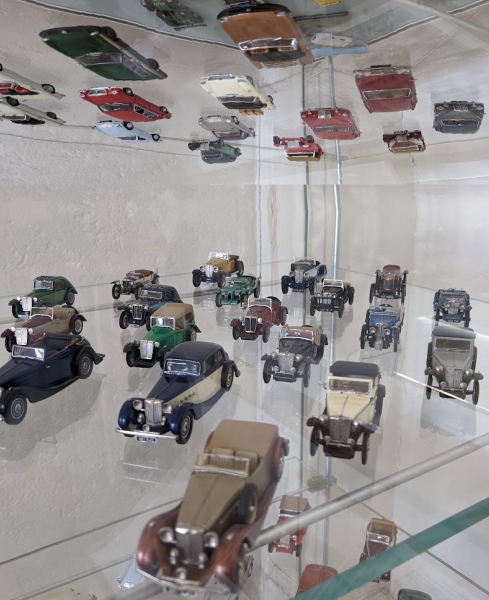
  • Vehicles on Display: A showcase of MG car models in a display case allows visitors to see dozens of models together.
  • Additional Exhibits: The exhibition features various artifacts including a section of the assembly track, and design drawings by Peter Neal. He is now the club archivist who collaborated with the museum staff in making the exhibition.

For more details about the exhibition, visit the Abingdon Museum website: https://www.abingdon.gov.uk/event/exhibition-mg-100-evolution-of-an-icon. Admission FREE.

The museum is financed and overseen by Abingdon Town Council.