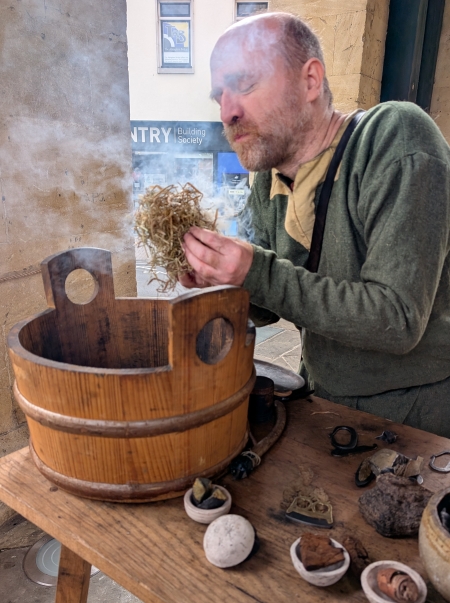
Abingdon Museum hosted Hwitmearum, a living-history group from the Oxfordshire branch of Regia Anglorum, dressed in Anglo-Saxon clothing and demonstrating some of the skills and activities of the early medieval period.
One member demonstrated traditional fire-making, striking flint against a steel striker and sending sparks onto amadou, the prepared tinder made from the spongy material of the hoof fungus. Once the amadou began to smoulder, he transferred the ember into a bundle of dry plant fibres and blew gently until the smoke turned to flame.
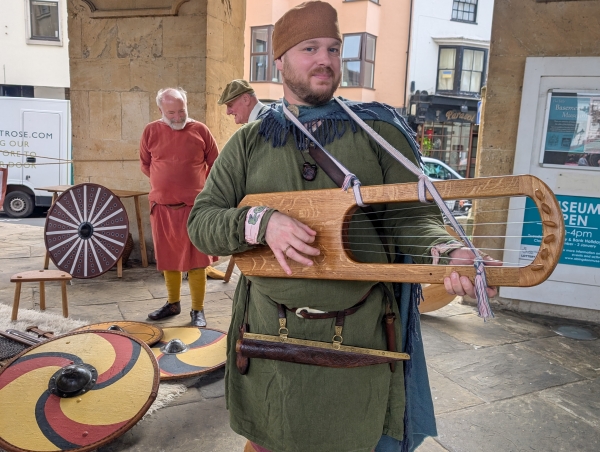
Another member demonstrated a lyre, reconstructed from the famous lyre found in the Sutton Hoo ship burial. Lyres were used in the early medieval period and are generally associated with music, poetry, storytelling and feasting. Unfortunately, no musical notation survives that allows us to know what Anglo-Saxon secular music actually sounded like, so modern performances are imaginative reconstructions.
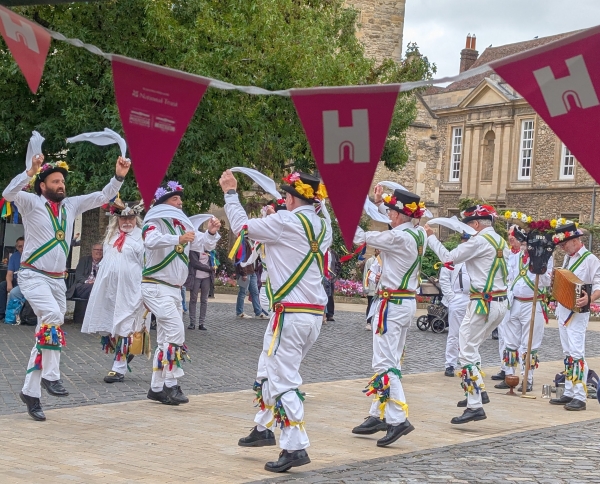
From early medieval music we moved forward a few centuries to a tradition that has been continuously passed down. The Abingdon Traditional Morris Men performed in the Market Place. Their history in the town can be traced back at least to 1560, when the parish churchwardens’ accounts for St Helen’s record a payment of one shilling for 24 Morris bells. Their roots may well be older.
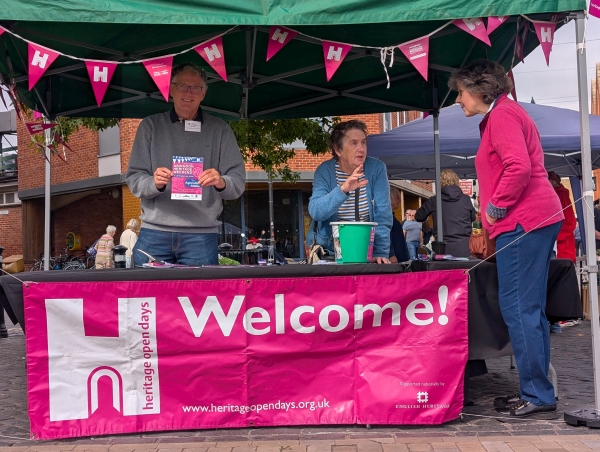
Also in the Market Place was the Heritage Weekend information stall, directing visitors to the various activities, together with a stall run by Abingdon Flower Club, where members were demonstrating flower arranging.
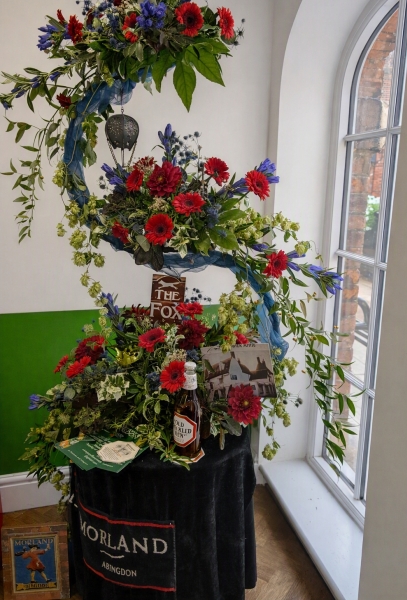
The club had also produced displays in exhibition spaces around the town to fit this year’s theme of Abingdon people at work. The Morland flower display had lots of old Abingdon pub emblems among the flowers. The Flower Club was founded in 1960, so it has now been going for more than 60 years. The art of arranging flowers has a much longer history. There is evidence of formal flower arrangements in ancient Egypt dating back to around 2500 BCE, with flowers being used in decoration, ceremonies and burials.
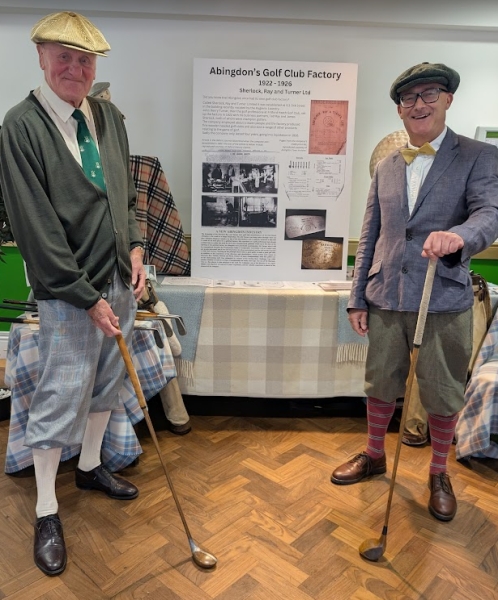
In the Roysse Room (more on that tomorrow) were displays about the workplaces of Abingdon. Outside the Roysse Room was an exhibit on a lesser-known enterprise: the Abingdon Golf Club Factory, which operated in Abingdon in the 1920s. The exhibition explained how the town aspired to become a centre for the production of golf clubs with Frilford Golf Club not far away. Manufacturing involved shaping and finishing wooden clubs, with metal parts brought in from elsewhere. Two golf enthusiasts posed with period clubs to illustrate the clubs.
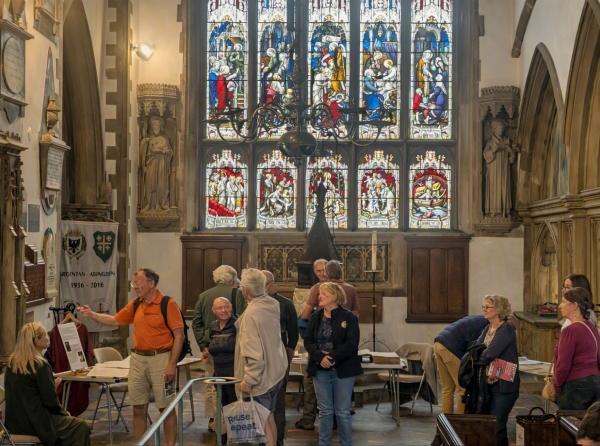
There were also a number of historic properties open to visitors. St Helen’s Church had a lot of information boards and old record books on display, including records relating to the workhouse that operated in the parish before the later Union Workhouse on Oxford Road. People queued for their turn to go up into the bell tower, while others were shown how the organ works. Refreshments were available there, and at St Ethelwold’s House.
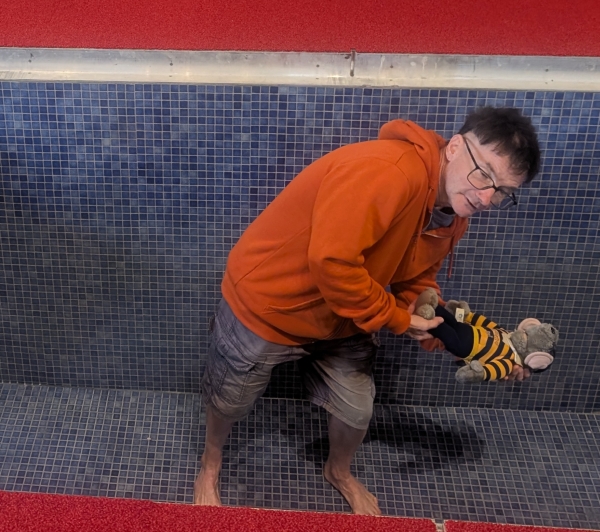
Another church open to visitors was Abingdon Baptist Church, where the baptismal pool was on view. I was told all about baptism and even given a practical demonstration using Roland Rat, who, after today, is probably the most well‑baptised rat in Abingdon.
More about Heritage Weekend tomorrow, when the exhibitions at the Guildhall and at 25 Bury Street will be open again, along with a programme of walks around the town. See https://www.abingdonheritage.org.uk/.
Have spent the day there. What some wonderful exhibitions and activities. Well done to everyone involved.
Where did an Anglo-Saxon get a steel striker from?